

You likely know me as an AI optimist.
At the same time, I’ve consistently advocated for using AI actively as a sparring partner rather than passively as a substitute for your own thinking.
Much of that is just my nature: I think best when I get to bounce ideas off of others, and AI often provides a great sounding board.
But I also always felt that uncritically trusting AI without human oversight is a profoundly bad idea.
Well, it turns out that—plot twist—uncritically trusting AI without human oversight is a profoundly bad idea.
Who would’ve thought?
Today, I want to take a quick look at the concept of “cognitive surrender” and what you might be able to do about it.
What is “cognitive surrender”?
“Cognitive surrender” refers to uncritically accepting AI outputs in place of relying on your own squishy brain.
The term was coined earlier this year by Wharton’s Gideon Nave and Steven Shaw in a research paper titled “Thinking—Fast, Slow, and Artificial: How AI is Reshaping Human Reasoning and the Rise of Cognitive Surrender.”
The study used a version of the cognitive reflection test and found that, even when AI output was wrong, almost 80% of participants still chose to go with AI answers without overriding them.
Man, 80% is, like…consults ChatGPT…almost half of all people!
So that’s, you know, not great.
But while the term “cognitive surrender” is relatively new, the risk of blind reliance on AI isn’t.
New name, old observations
Look, I don’t mean to toot my own horn, but…
…with that out of the way, I want to share a few posts where I warned against cognitive surrender well before that combination of words was used to describe it.
Back when ChatGPT first rolled out AI web search, I explicitly called out the risk of entrusting your research wholesale to a chatbot:

Here’s what I wrote:
And even if AI summaries are magically 100% accurate, what will be the long-term effect of us settling for condensed AI snippets instead of doing our own deep research?
My fear is that at least for a while, AI search will only amplify the Dunning-Kruger effect, giving us the illusion of knowledge by pacifying us with a seemingly authoritative filter between ourselves and the source.
But beyond just being a wise guy who points out the “wrong” way to do stuff, I also shared my ideas on what the “right” way might look like:
In “The Skeptical Writer’s Guide to AI,” I showed how writers could use AI while staying in the driver’s seat and not giving up what matters.
In “How to Level Up Your Job Hunt With AI,” my main message was to use AI to make yourself a better candidate instead of automating the application process.
In “How to Master New Topics with AI,” I covered a few approaches to turning AI into a tool that helps you learn instead of doing the thinking for you.
Hopefully, reading these posts will help you embrace AI while keeping your critical thinking intact.
Also, if you’re specifically trying to learn a new subject or understand a concept, remember to switch on the dedicated “study” mode in your chatbot of choice:

Are there other things you can do to avoid surrendering to AI?
Well…
5 habits that help prevent cognitive surrender
Cognitive surrender isn’t always a single clear instance. It may well creep up over time as you gradually trust AI more and more at the cost of exercising your own judgment.
One way to fix this is to read every Why Try AI post ever written.
If, for some odd reason, that’s not on your bucket list, here are a few other ways you can train yourself to stop deferring to AI.
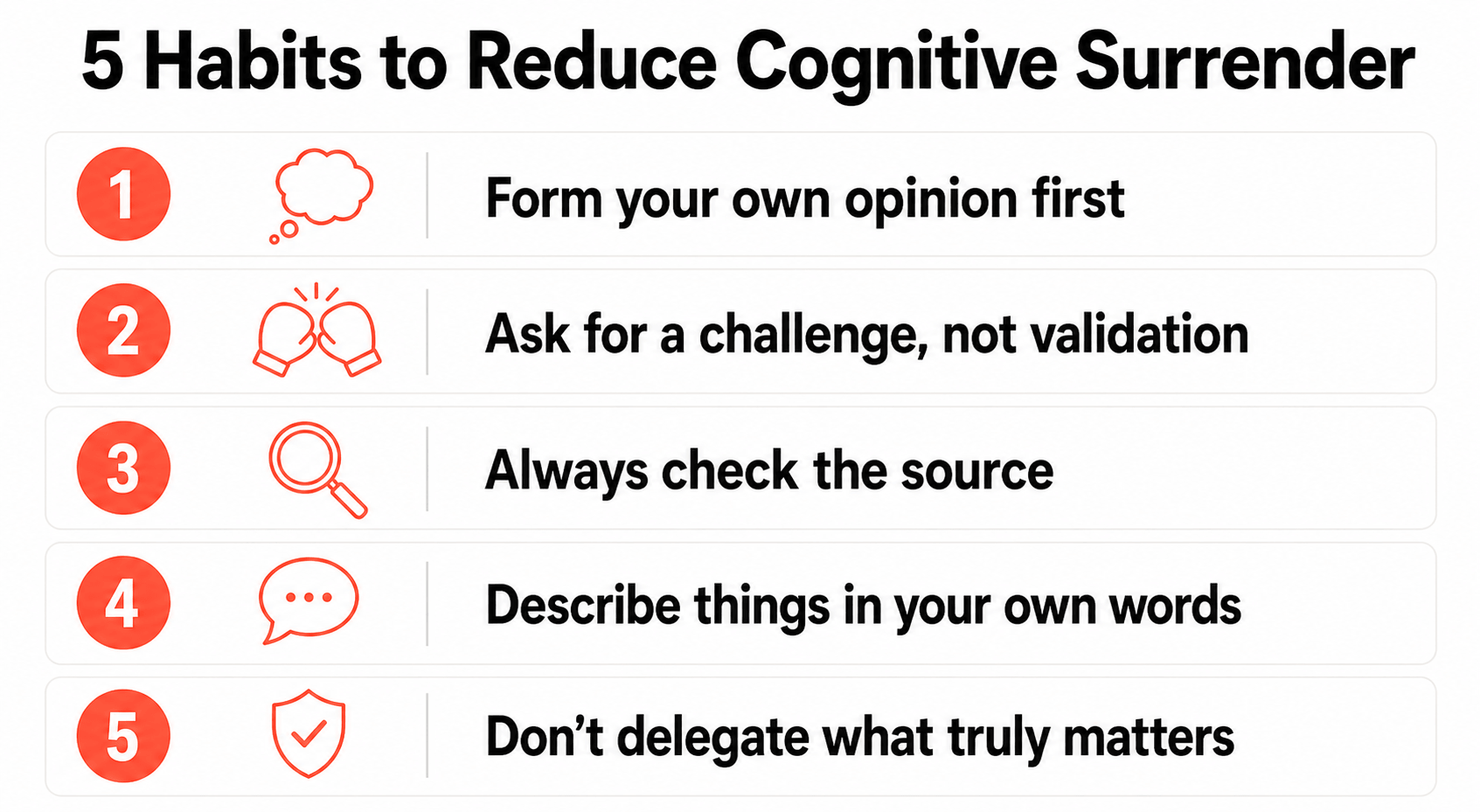
Habit #1: Form your own opinion first
Before you ever ask AI for input, formulate your own take.
It’s okay if it’s just a few scribbled notes or a stream-of-consciousness rant you dictate into a microphone. The important part is doing your own legwork instead of letting AI do it for you.
If you know where you stand, you won’t accept AI output without pushback.
Habit #2: Ask for a challenge, not validation
Instead of turning to a chatbot with an open-ended “What do you think?”, try to intentionally invite friction by asking AI to poke holes in your assumptions, point out what you might have missed, find counterarguments, and so on.
AI chatbots are notoriously sycophantic, but asking one to stress test your ideas nudges it out of this default behavior. I shared seven anti-sycophancy tips here:

Habit #3: Always check the source
I mean, this has been a good rule of thumb even in the pre-AI era.
If a chatbot cites a verifiable fact or figure, go to the source. Does the source actually say what AI claimed, or was it just a confident hallucination? What’s the context around the claim, and does it change the picture AI presented?
Understanding where a piece of information came from and how it was obtained is often as important as the information itself.
Habit #4: Describe things in your own words
After you get a finished product or output from AI, pretend you’re giving your imaginary friend1 an executive summary.
If you can easily find the right words, your brain has been engaged in the process.
But if you struggle, that’s a good sign you might be deferring to AI a tad too much. Revisit the task and see if you can internalize what AI’s been doing.
Habit #5: Don’t delegate what truly matters
Here’s how I try to approach AI: If a task is my primary deliverable, my core area of expertise, or simply something I’m passionate about, I never let AI do it for me. Sure, I might ask AI for a second opinion, but the bulk of the effort and output will come from me.
For instance, no matter how good AI gets at writing, I’ll still be stringing my own words together. That’s because I like writing. I get a kick out of sprinkling in silly asides and jokes and knowing nods to my audience. (You know who you are, Fred, wink wink.)
But I’ll happily turn to AI for filler videos or images or other visuals to supplement my writing, because a) I suck at most visual arts and b) it’s not a skillset I want to develop or consider critical to my identity.
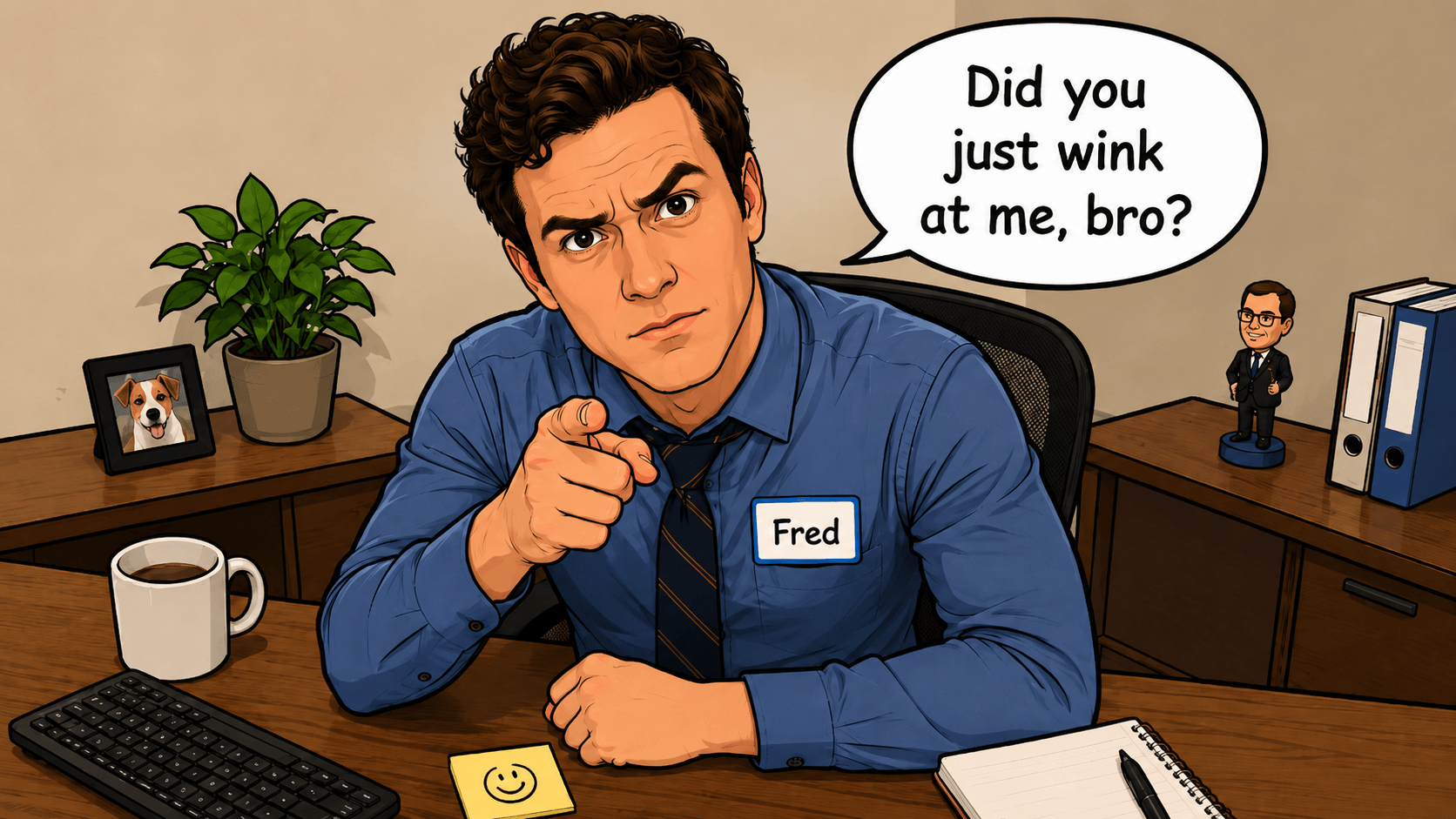
You might be the exact opposite of me: a passionate cartoonist who won’t be caught dead using AI to create images, but who’ll happily hand tedious writing tasks to the first chatbot you come across. And your name is Leinad.
The point is that you should protect the work that makes you who you are while letting AI handle the busywork, however you define that in your role.
That way, you won’t have to watch your creativity and thinking muscles atrophy.
Here’s a quick reference sheet:
For an additional perspective, check out this wonderful TED Talk by Advait Sarkar:
Thanks for reading!
If you enjoy my work, here’s how you can help:
❤️Like this post if it resonates with you.
🔄Share it to help others discover this newsletter.
🗣️Comment below—I love hearing your opinions.
Why Try AI is a passion project, and I’m grateful to those who help keep it going. If you’d like to support me and unlock cool perks, consider a paid subscription:
This tip assumes you have an imaginary friend. If you don’t, I can provide you with a loaner imaginary friend, but you must promise to give him back.
When Claude doesn’t give me the answer I want, I go to ChatGPT and whine about it. If I still don’t like that answer, I ask Gemini. I call it the triangle of sycophancy.
Your recipe only works for the percentage of the population with suitable intelligence to do their own thinking. It's a rapidly declining percentage!
"...think about how stupid the average person is, and then realize that half of 'em are stupider than that."
--George Carlin