

Hey, remember how I once cautioned against blindly trusting chatbots with web search?

And then everyone was like, “Yup, Daniel has a point, let’s scrap the idea.”
And all AI labs cancelled their web search implementations.
And nobody asked a chatbot to research anything ever again.
Remember that? Good times!
Anyway, let’s return from La-La Land back to reality, where over 50% of all search engine volume is now driven by AI assistants.
I’m not immune to this, by the way.
I now turn to chatbots and agents for my research far more often than to Google.
But did you know that the language of your AI chats might inadvertently limit your perspective?
Let me show you what I mean and how you can do better.
The “language lens” problem
You might think that when you ask a chatbot a question, it diligently combs the entire Internet, gathering information from all around the world to give you a global synthesis.
But nope.
That’s not what happens.
Instead, the chatbot searches the Internet as you would, in your language.
This seems like a minor nitpick, but this approach often overlooks local perspectives.
Let’s try a simple search for Denmark news in ChatGPT:
Prompt: Summarize the five biggest news stories about Denmark of the past week. Just a concise one-sentence bullet for each item. Make it easy to skim.
Here’s what that gives us:
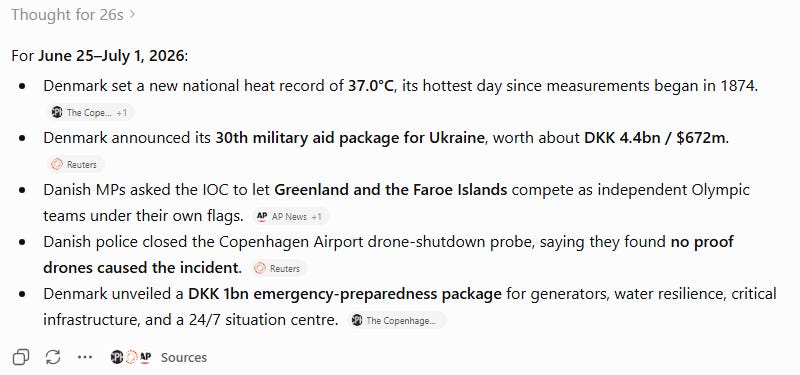
Seems solid.
But now watch what happens when I add a simple language anchor:
Prompt: Summarize the five biggest news stories about Denmark of the past week. Just a concise one-sentence bullet for each item. Make it easy to skim. Search in Danish. Reply in English.
Here’s the new list:
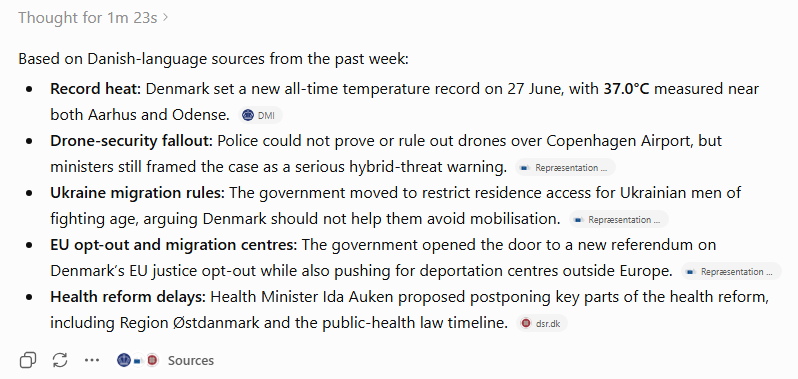
While there’s definitely some overlap (record heat, airport drones), the Danish-anchored perspective is different in several ways:
The overall mix is more local and inside-out (migration laws and health reform) instead of geopolitical (Greenland and Ukraine military aid).
The mix of sources is exclusively Danish, compared to the original’s Reuters, AP News, and The Copenhagen Post (English-language newspaper for internationals).
The search took almost one-and-a-half minutes (compared to just 26 seconds in English), indicating that ChatGPT had to dig harder to surface local sources.
What this shows is that the chatbot’s answers are subtly tainted by your query language. (Unless you proactively counteract it.)
That’s the language blind spot in action.
Uh...so what?
This might feel like a non-issue if all you’re after is a quick at-a-glance view.
But there are situations where a local perspective is genuinely helpful.
The hidden superpower of large language models isn’t that they can summarize stuff. It's that they can search and understand parts of the web you'd never explore yourself.
Language barriers largely don’t exist for chatbots.1
Think of what that means.
You can learn what Chinese media outlets actually write about a trade dispute, not a summary of China’s perspective from Reuters.
You can find authentic reviews of a Japanese product directly from Japanese sites.
Or consult a German health forum about a treatment before going to a local clinic.
Or discover hidden gems in a Brazilian town that locals actually prefer to visit.
And so on.
The fix: ask AI to search locally
The trick is to explicitly ask the chatbot to search local sources in a specific language, as you already saw with my Danish news example.
Use this:
Prompt: [My question or request]. Search [location] sources in [language]. Reply in [my language].
Add this location/language line to any research prompt, and your chatbot will pull info from local sources and translate the findings for you.
This approach works with virtually any query where a local perspective matters.
Limitations & caveats
Of course, even this kind of local-aware search isn’t perfect.
Here are some limitations:
Online only: You’re still at the mercy of what’s actually available digitally. Local TV channels, magazines, and newspapers are out of your reach.
Accessibility: Not every site is crawlable by AI agents and chatbots, so even if the content exists, they might not find it.
Popularity bias: Chatbots are likely to surface well-ranked results rather than lesser-known or smaller sites.
Source quality: Chatbots may include results from questionable sources or state-controlled outlets without making this transparent.
Verification friction: With results in your language, you can go to the source and double-check AI’s answers. With foreign-language sources, this gets trickier.2
Still, inviting a local perspective is almost always better than settling for vanilla results.
Bonus: My “Global Pulse” skill (+prompt)
That above one-line addition will already upgrade your research.
But it gives you a single search in a single language.
I’m a big fan of what Ground News does for news coverage, showing how different sources cover the same story.
I wanted something like that, but across languages and not only for news.
So I built a Global Pulse skill for Claude Code (or any other local agent).3
Hand it your research query and a list of countries to cover.
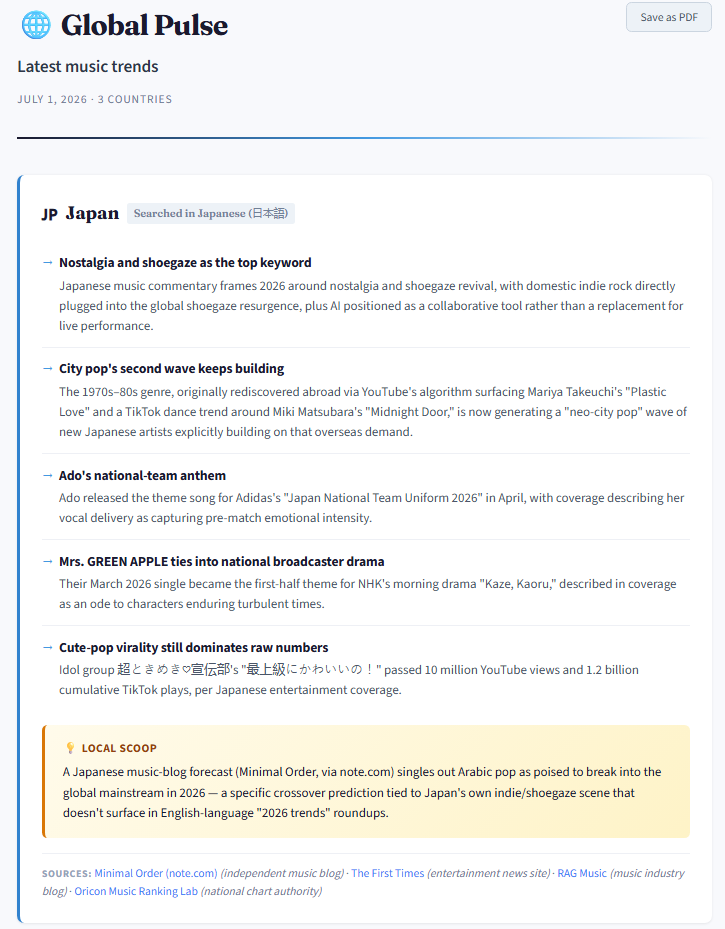
Global Pulse then searches local sources, compares perspectives side by side, uncovers unique local-only insights, and much more.
You get a polished HTML report that shows you:
A dedicated per-country summary with key findings and local scoops
A clickable list of sources per country for further exploration
A cross-country synthesis with the full range of perspectives
Here’s a one-country sample teaser:
For those who don’t use AI agents or want a simpler solution, there’s also a copy-paste prompt (750+ words) that works in any chatbot with web search.
Grab the “Global Pulse” skill-and-prompt combo here:

Thanks for reading!
If you enjoy my work, here’s how you can help:
❤️Like this post if it resonates with you.
🔄Share it to help others discover this newsletter.
🗣️Comment below—I love hearing your opinions.
Why Try AI is a passion project, and I’m grateful to those who help keep it going. If you’d like to support me and unlock cool perks, consider a paid subscription:
This is only true for languages present in the training data, which varies model to model.
Sure, you can always visit the site and run it through something like Google Translate, but this adds extra steps that most people will skip, deferring to the chatbot anyway.
Tested this with geopolitical research and the gap is staggering. Search for Iran coverage in English and you get Western analysis filtered through Western assumptions. Add Farsi and Arabic sources and an entirely different picture emerges, with details, timelines, and domestic political dynamics that don't exist in the English-language version. Same event. Different realities. The language you search in determines the world you see, and most people only see one.
I just wanted to say that I am glad I stumbled across your page via Chris. I’ve found that once I enhanced my prompts my responses improved tremendously. Just a simple phrase “using reputable resources” is one that I’ve found powerful. Looking forward to reading more of your work. Thanks again.