

I’m traveling with the family, so the next Rundown will be on February 22.
Happy Sunday, friends!
Welcome back to the weekly look at generative AI that covers the following:
Sunday Rundown (free): this week’s AI news + a fun AI fail.
Sunday Bonus (paid): an exclusive segment for my paid subscribers.
In case you missed it, here’s this week’s Thursday deep dive:

If you’re consistently missing out on my emails, remember to check your “Promotions” tab and mark whytryai@substack.com as a “Safe Sender.”Let’s get to it.
👩💻 AI releases
ACE Studio open-sourced ACE-Step v1.5, a music model that can create 4-minute songs in under 10 seconds in 50+ languages. (Try the demo.)
Adobe Firefly is offering unlimited AI image and video generation with all third-party partner models for paying subscribers until March 16.
Alibaba open-sourced Qwen3-Coder-Next, a hybrid attention model optimized for coding agents and local development.
Amazon launched the Amazon Ads MCP Server, which lets different AI agents create and manage ad campaigns through a single integration.
Anthropic news:
Claude Cowork plugins let you bundle skills, connectors, slash commands, and sub-agents into complete packages for a given role or process.
Claude in PowerPoint is an add-in that can generate and edit PowerPoint slides using your brand assets. Only for Max, Team, and Enterprise for now.
Claude Opus 4.6 boasts improved agentic coding, a 1M-token context window, adaptive thinking, and agent teams for Claude Code.
ElevenLabs fully released Eleven v3, the cutting-edge TTS model that speaks 70+ languages and can use audio tags like [whisper] and [sigh].
Kling AI launched Kling 3.0 with superb character and element consistency, 15-second clips, and upgraded native audio.
Malwarebytes is now available inside ChatGPT, so you can check suspicious texts, emails, or URLs by typing “@Malwarebytes, is this a scam?”
Mistral AI open-sourced Voxtral Transcribe 2, an on-device speech-to-text model with sub-200ms latency that can transcribe 13 languages.
OpenAI news:
Codex app for macOS lets you run multiple AI coding agents in parallel in a unified workspace with built-in worktrees and automated schedules.
GPT-5.3-Codex is the company’s most capable agentic coding model that’s 25% faster, tops multiple benchmarks, and helped build itself.
Perplexity news:
Deep Research is now powered by Claude Opus, returning better quality analysis and research from harder-to-reach sources.
Model Council runs the same query in three separate models, then synthesizes a single answer. (Only for Max subscribers on the web so far.)
Roblox launched 4D generation in open beta, letting users create interactive 3D objects that can follow the players’ instructions.
Vercel rebuilt v0 so AI-generated apps can be shipped straight to production with proper GitHub workflows and real deployments.
WordPress released wp-playground, a skill that lets agents spin up WordPress installs to run, verify, and iterate on plugins and themes much faster.
xAI released Grok Imagine 1.0, with up to 10-second 720p video generation, expressive characters, and “dramatically better audio.”
📖 AI resources
Kaggle Game Arena [BENCHMARK]: watch AI models compete at games like chess, poker, and Werewolf with live leaderboards.
DeeVid Image to Video AI [TOOL]: a one-tap animation tool that turns a photo or multiple images into short clips with smooth camera transitions
[sponsored]DRACO [BENCHMARK]: an open-source benchmark by Perplexity to evaluate deep research agents (Deep Research Accuracy, Completeness, and Objectivity).
RentAHuman [MARKEPLACE]: an experimental platform that lets AI hire humans to perform physical tasks in the real world.
Sora Feed Philosophy [ARTICLE]: an interesting look into how OpenAI Sora’s recommendation algorithm balances creativity, safety, and personalization.
🔀 AI random
Anthropic’s series of Super Bowl ads poking fun at the idea of chatbot ads got OpenAI’s Sam Altman to pen a defensive response, sparking a bit of online drama.
🤦♂️ AI fail of the week
Ouch…and you were so close! (Imagine that, Grok.)
💰 Sunday Bonus #89: 9 simple-yet-powerful Claude Code workflows for everyday users
In case it wasn’t blindingly obvious from my Claude Code Trilogy, I’m really digging Claude Code these days.
Back in January, I shared a swipe file with 100+ use cases and starter prompts.
But a list of applications for inspiration is one thing. Knowing exactly how to get started is another.
So today, I bring you The Claude Code Playbook: nine ready-to-use workflows designed for non-coders, complete with copy-paste prompts. Each one is easy to kick off but gives you something real: an organized folder, a working app, a redesigned process, and so on.
The first one is the “getting started” tip from my last article. The rest build on it:
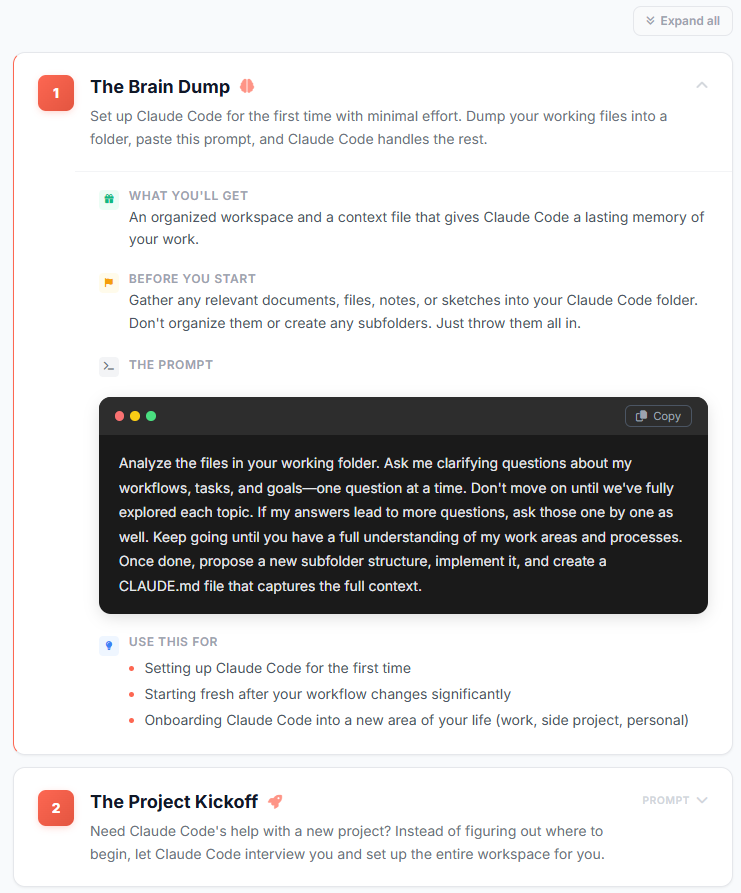
The workflows cover everything from improving your existing processes to bulk-organizing files or turning raw data into interactive dashboards.
Have at it: