

TL;DR
Sora 2 is a genuinely impressive video model, but it’s baked into a social media app built for ultra-short meme clips, which undersells its creative potential.
What is it?
When OpenAI first teased its original Sora model back in February 2024, people went nuts. But Sora wouldn’t launch to the public until December, and by that time, it was well behind many top-tier video models.1
With Sora 2, OpenAI is convincingly back in the game:
There’s a lot to like about Sora 2.
It can handle complex physics, including intricate scenes like gymnastics and fight sequences. It can create videos in many different styles. And, like Veo 3, Sora 2 natively generates its own audio effects and dialogue.
While there are no third-party benchmarks or leaderboard rankings yet, Sora 2 feels roughly on par with Veo 3 (depending on the use case).
Here are three quick comparisons of my own:
Prompt #1: Over-excited blonde influencer is holding a smartphone with the Substack feed on it. She near-screams: “You guys have to check out Why Try AI. It’s so, so good. But what do I know? I don’t even exist!”
Veo 3:
Sora 2:
I don’t know why both models decided to throw in a semi-psychotic giggle at the end, entirely unprompted, but here we are.
Prompt #2: A drunken 1800s pirate tries to use a modern laptop but can’t figure it out. In frustration, he bangs the keys and says “Blast this shiny chest o’ letters—won’t open no matter how I pound it!”
Veo 3:
Sora 2:
I love the bonus details, from Veo 3’s exploding laptop to Sora 2’s off-script method acting improv.
Prompt #3: A horse wearing a top hat tap dances to music on its hind legs
Veo 3:
Sora 2:
Veo 3 looks more realistic, but I like how Sora 2 came up with an entire jingle. No true dancing on hind legs from either model, however.
The bottom line is that both are impressive and not too far apart.
How do you use it?
First, a whole bunch of caveats:
The Sora app is only available for iOS for now. We Android users can go fish.
It’s only out in the US and Canada. (But a VPN works.)
Access is invite-only, so you’ll have to wait or actively hunt for codes.
Here’s the general process:
Download the iOS app or visit sora.com.
Sign in with your ChatGPT account.
If you don’t have an invite code, see below.
Once you have an invite code, enter it to gain access:
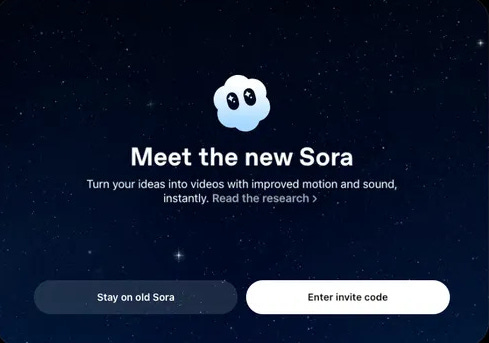
Now you get the familiar prompt box to generate videos. All clips default to 9 seconds. The only thing you can tweak is the orientation (portrait or landscape):

Enjoy your Sora videos:
So, how do you get an invite code?
You’ve got a few options:
Wait patiently until OpenAI rolls out Sora 2 more broadly.
Hunt for new codes on forums like this Reddit mega thread.
Try obsessively refreshing sora-invite.vercel.app (that’s how I got my code).
Ask a friend who has invite codes to share.
On that note, I’ve been given 4 invite codes when I signed up. Send me a message if you want one. My paid subscribers get priority, but if none of them want a code, I’ll happily give it to any of my readers.
Why should you care?
As much as I like Sora 2 itself, two things bug me about this launch.
First, the invite-only rollout.
This predictably annoyed existing paying customers, especially those on a $200 / month Pro account:
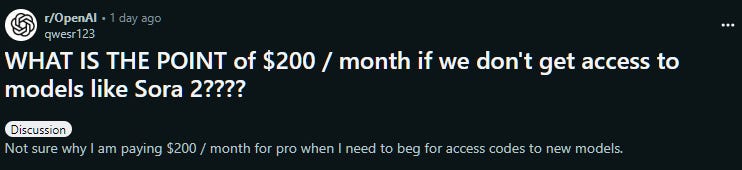
But beyond that, it triggered a proper frenzy with Reddit code-sharing megathreads and shady “codes for money” schemes.
Not exactly a feel-good start.
Secondly, and more importantly, OpenAI has chosen to lean heavily into the “social media app” aspect with this rollout.
On the Sora 2 announcement page, OpenAI has some lofty words about general-purpose world models and how life-changing they will be:
Since then, the Sora team has been focused on training models with more advanced world simulation capabilities. We believe such systems will be critical for training AI models that deeply understand the physical world.
[…]
General-purpose world simulators and robotic agents will fundamentally reshape society and accelerate the arc of human progress. Sora 2 represents significant progress towards that goal. In keeping with OpenAI’s mission, it is important that humanity benefits from these models as they are developed.
But here’s how they position the mobile app:
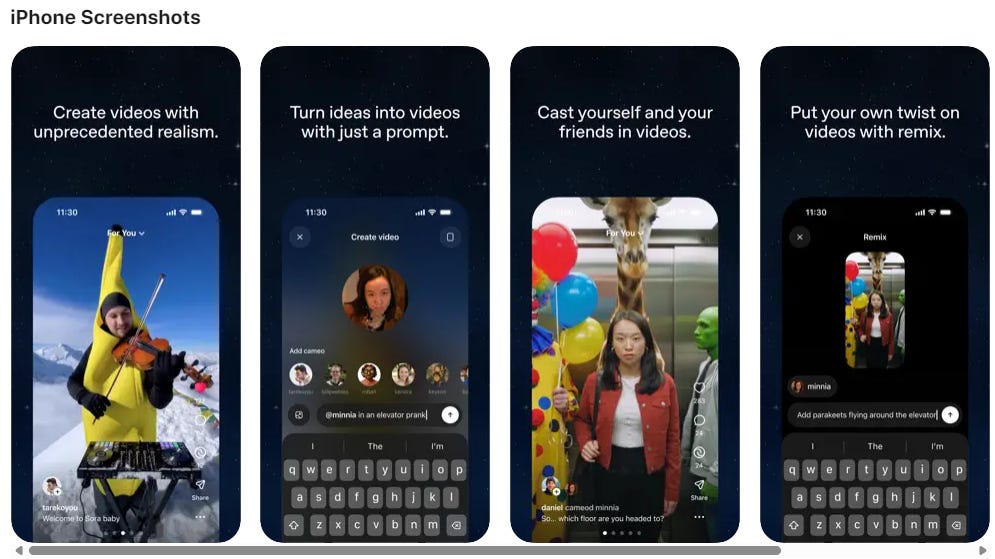
“Accelerate the arc of human progress,” indeed.
The team spends most of the Sora 2 livestream talking about the social app and its many gimmicks, from video remixing to “Cameos” that let you insert yourself and friends into short video clips.
Look, I like silly shenanigans as much as anyone.
My Sora 2 tests are drunk 1800s pirates and tap-dancing horses.
I’m also bullish on AI's potential to unlock our inner creators and help us tell stories we otherwise couldn’t. Here’s my first-ever post on this very Substack:

But I’m not sure we need yet another social media app with an endless feed of hyper-short video clips.
It’s the “Studio Ghibli version of my face” moment all over again, except this time OpenAI is actively encouraging it.
We have so many short-form dopamine machines already, do we need one built exclusively around AI slop?
Is “Remix this viral meme but with me in it” the pinnacle of our creative potential and the best proof-of-concept use case for a video model as powerful as Sora 2?
To their credit, the OpenAI team appears to have given serious thought to what a responsible social app rollout might look like, at least on paper.2 They talk about steps to prevent doomscrolling, encourage creation vs. consumption, and so on.
Then again, I’m sure the Jurassic Park staff also had seemingly robust safety procedures in place. Also, here’s something that applies equally to both:
Google has always positioned Veo 3 as a tool for serious filmmakers with its Flow platform.
OpenAI, instead, is betting on mainstream appeal and shareability with a meme slop slot machine.
As far as winning the attention game goes, OpenAI’s play is clearly the right move.
But as someone who tries to see AI as a force for good, I can’t help but feel this is a step in the wrong direction.
🫵 Over to you…
What’s your take on OpenAI’s social media play? Does it discredit Sora’s promise by turning it into a viral gimmick, or is it just a fun way to reach more users? Do we need more endlessly scrolling social apps in our lives? Is the “Cameo” feature awesome or dystopian? Am I just an old man yelling at clouds?

Leave a comment or drop me a line at whytryai@substack.com.
Thanks for reading!
If you enjoy my writing, here’s how you can help:
❤️Like this post if it resonates with you.
🔄Share it to help others discover this newsletter.
🗣️Comment below—I love hearing your opinions.
Why Try AI is a passion project, and I’m grateful to those who help keep it going. If you’d like to support my work and unlock cool perks, consider a paid subscription:
You’ll have to scroll to #16 to spot Sora on this leaderboard (at the time of writing)
Further reading on the topic:
“Launching responsibly” section of the Sora 2 launch page.
Sam Altman’s blog posts with his thoughts on the social media app.
I've got two main thoughts here (which I'm debating writing more about):
1. It's interesting how OpenAI and Meta are targeting different parts of social media's 90/10/1 funnel (90% of users consume, 10% engage, 1% create). The Vibes app is after the 90% who will be consuming AI generated content, while the Sora app is closer to the 10% who will edit/remix friends' content.
2. Hey, maybe don't voluntarily put your likeness into an AI-cloning app. Maybe I'm being paranoid about this, but it reminds me of early 23andMe users - in the end, their genetic data was nearly sold to the highest bidder as the company went bankrupt.
Generally agree with your take- not sure how all the $$ and the brilliant minds feel this is the great path forward for humanity and AI. Heck , even just for generative AI, is it just another tool for doomscrolling dopamine hits?
I came to you just after posting my little reaction on this, looking for what others might have to say! :)
https://substack.com/profile/87890550-abhishek-rao-shakey/note/c-163813180