

Ladies and gentlemen.
Fellas and fellow-ettes.
It’s that time of the year again.
Some would say it’s the most wonderful time of the year. (Unless they’re McDonald’s.)
Most of us are winding down for the holidays, including yours truly. This will be my last new Thursday post of 2025, although I’ll likely dust off something from the archives to rerun in the next two weeks.
But before I go, I want to revisit my predictions from early January:

I made exactly seven of them, and now it’s time to find out how accurate they were by rating them as:
✅ = Accurate
🟨 = Partially accurate/mixed
❌ = Wrong
Let’s go!
✅ 1. Reasoning models converge
My prediction (more context here):
By the end of 2025, reasoning models from at least three other players will perform on par with or better than OpenAI’s o3.
Reality:
This one’s pretty clear-cut.
When I wrote the prediction, o3 was a yet-to-be-released SOTA reasoner, but “test-time compute” was clearly becoming the go-to paradigm. So, it was only a matter of time before other major players released their own versions.
And they did.
Here’s the latest snapshot from Artificial Analysis:
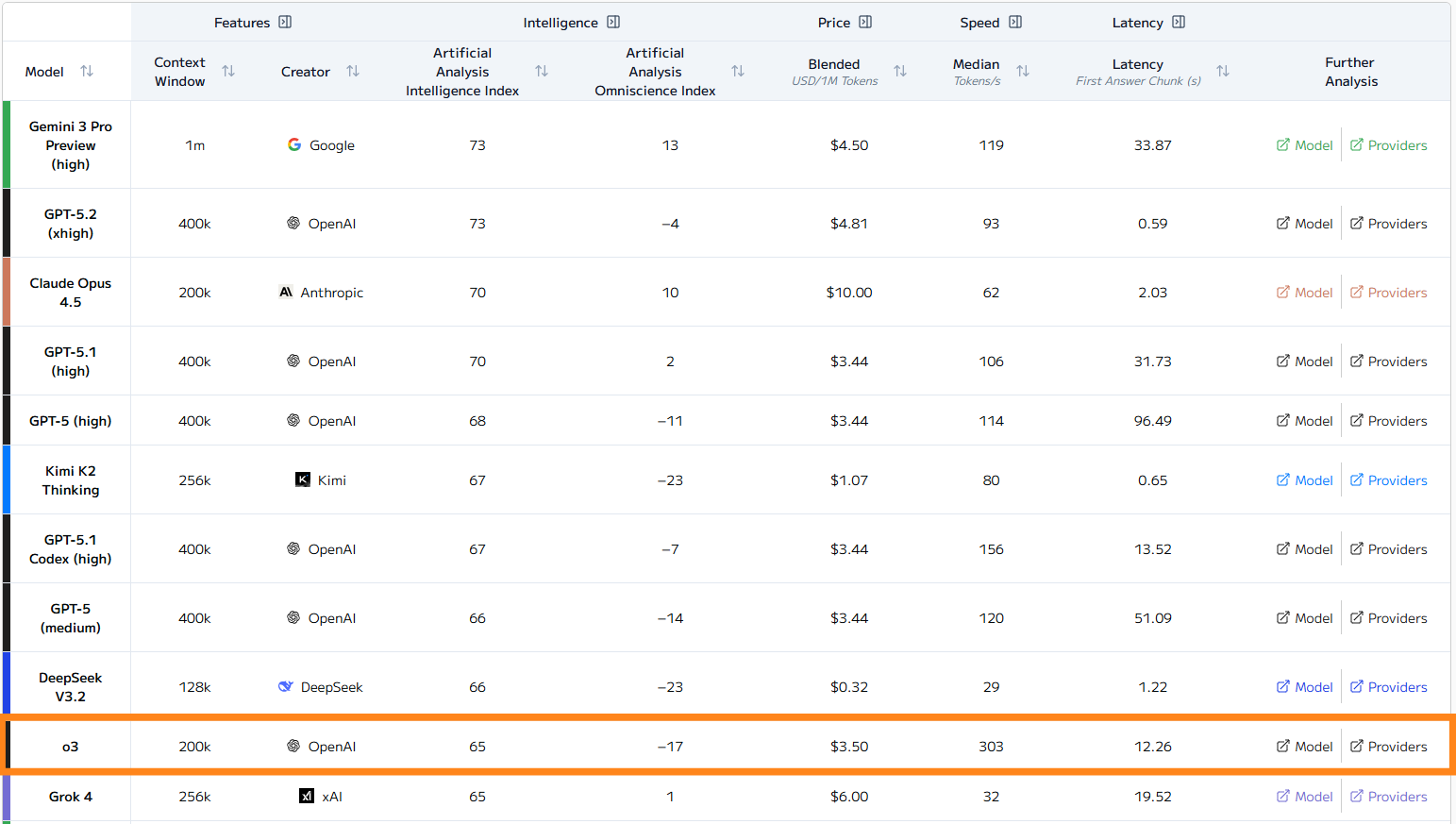
While o3 still holds up,1 models from four different OpenAI competitors score higher:
Anthropic (Claude Opus 4.5)
Google (Gemini 3 Pro)
DeepSeek (DeepSeek V3.2)
Kimi (Kimi K2 thinking)
So we can safely mark this one as correct.
Verdict: Accurate ✅
🟨 2. AI video goes mainstream
My prediction (more context here):
By the end of 2025, a major movie—either released or announced—will feature at least some scenes made entirely using text-to-video models.
Reality:
This one’s iffy.
On the one hand, there’s no doubt that AI video went very mainstream this year.
Hell, 90% of your social media feed is just AI slop clips at this stage (thanks, Sora 2).
In July, the world’s first fully AI-generated “actor” Tilly Norwood made a splash.
We’re seeing more and more articles like these:
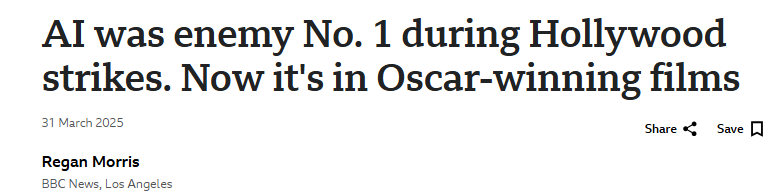

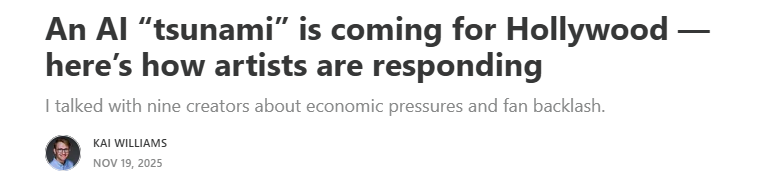
And just a week ago, Disney announced a major agreement with OpenAI that lets Sora use Disney characters and plans to feature user-created AI short videos on Disney+.
On the other hand, if we stick to the letter of my prediction, I can’t find any “major movie” that features scenes made “entirely using text-to-video models.”
The closest example is the upcoming OpenAI-backed short film “Critterz,” set to debut at the Cannes Film Festival in 2026. Hardly a massive blockbuster.
But since my prediction was directionally correct and AI video truly hit the mainstream this year, I’ll award myself a “mixed” rating. Because if I don’t, who will?
Verdict: Mixed 🟨
✅ 3. Actually useful AI agents
My prediction (more context here):
By the end of 2025, an AI agent will be able to reliably automate at least three common, well-defined workflows in business software.
Reality:
This is an easy win. My prediction was a tad conservative, now that I think about it.
Articles by the Harvard Business Review and the World Economic Forum specifically point out how AI agents aren’t always consistent for customer-facing tasks but are already reliably automating repetitive, administrative internal processes.
We have agents for helpdesk automation, email handling, customer relationship management, and many more.
Most AI companies also launched their own versions of agent automation and agent creation tools, with varying degrees of complexity.
So it looks like we’ve easily passed the rather low “three common workflows” bar.
Verdict: Accurate ✅
❌ 4. No “GPT-5” (ever)
My prediction (more context here):
OpenAI will never release a model called GPT-5. Instead, the company will focus on the “o” family of reasoning models. Any performance improvements to “traditional” LLMs will be released as GPT-4x iterations or a rebranded family.
Reality:
Boy, was this one off!
OpenAI went ahead and named its hybrid reasoning model “GPT-5” after all:

While it’s true that OpenAI essentially moved away from traditional “pure” LLMs, I definitely was off when I prematurely buried the “GPT-5” naming convention.
Verdict: Wrong ❌
✅ 5. AI tutors are formally integrated
My prediction (more context here):
By the end of 2025, a top-tier university will use an AI tutor to scale an accredited degree program and make it accessible for remote students from around the world.
Reality:
I initially gave this one a “mixed” score.
But after some digging, I found at least two examples that suggest I wasn’t too far off, actually:
Penn Engineering (Ivy League, #17 engineering school in the US.)
Launched “Jean,” a 24/7 AI Tutor, in May 2025, explicitly capable of helping “graduate students in different time zones stay on track and receive immediate feedback and guidance.”
The University of Texas at Austin (#1 Public University in Texas, #7 in the US.)
Launched “UT Sage,” a homegrown “AI Tutor Platform” in July 2025 that offers students “on-demand, course-specific support that complements classroom instruction and reinforces foundational knowledge.”
As an aside, Georgia Tech apparently had a basic AI teaching assistant called Jill Watson since way back in 2016, and overhauled it using OpenAI’s models this year.
So I feel like this one holds up, but I’m open to being challenged.
Verdict: Accurate ✅
❌ 6. Model transparency becomes mandatory
My prediction (more context here):
By the end of 2025, we’ll have a law that requires AI companies to publish “nutritional labels” for models of a certain size or capability, specifying things like energy consumption, data sources, etc.
Reality:
I think it’s safe to say this didn’t happen.
If anything, we moved in the opposite direction, at least in the US. The executive order “Ensuring a National Policy Framework for Artificial Intelligence” not only sets up a lax, “minimally burdensome national standard” for AI companies but also bans states from introducing their own AI regulations.
In fact, the executive order goes directly after any identified state laws that “compel AI developers or deployers to disclose or report information,” calling such laws “onerous.”
In the EU, things are a bit closer to my prediction. Under the AI Act, the “Guidelines on obligations for General-Purpose AI providers” state the following:
“Providers of general-purpose AI models must […] publish a sufficiently detailed summary of the content used for training the model.”
[AND]
“Providers must draw up and maintain comprehensive technical documentation for authorities. This includes information about the model’s architecture, training process, training, testing, and validation data, computational resources, and energy consumption. This documentation must be made available to the AI Office upon request, which may also act on behalf of national competent authorities.”
That sounds very nutrition-labely. At the same time, this isn’t a strict public-facing disclosure requirement but a “have your documentation in order in case we want to check it” kind of deal.
All in all, I don’t feel this prediction deserves even partial credit.
Verdict: Wrong ❌
✅ 7. Google dethrones OpenAI
My prediction (more context here):
By the end of 2025, Google, not OpenAI, will be widely seen as the dominant player in generative AI.
Reality:
Look, we all know that “ChatGPT” is to chatbots what “Google” (still) is to traditional search engines. OpenAI’s mindshare among the mainstream audience is real.
But when it comes to both metrics and the evolution of general sentiment, the shift toward Google has been hard to miss.
First, the rankings.
Google now has…
The world’s #1 large language model (Artificial Analysis metrics and LM Arena real-world user ratings.)
The world’s #2 text-to-image model (Artificial Analysis metrics and LM Arena users.). It was #1 but just got overtaken by OpenAI’s new “GPT Image 1.5.”
The world’s best video model (in both text-to-video and image-to-video.)
Next, the sentiment.
Here’s an unfiltered snapshot of my “Google vs. OpenAI Reddit” search:
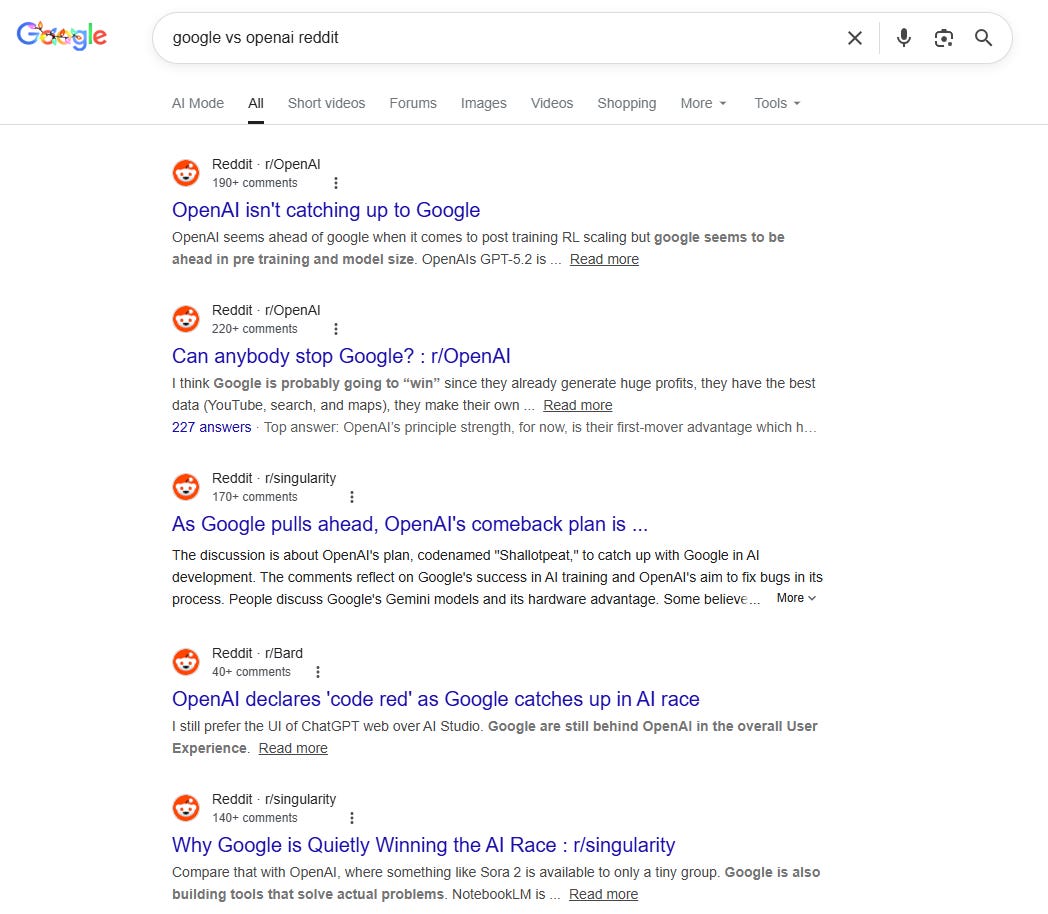
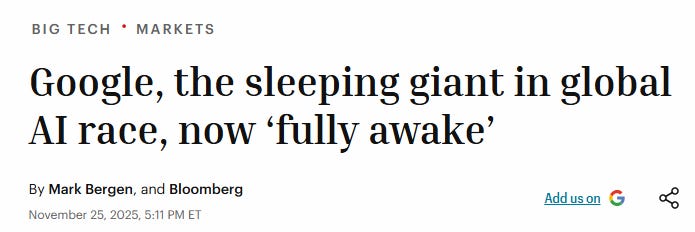
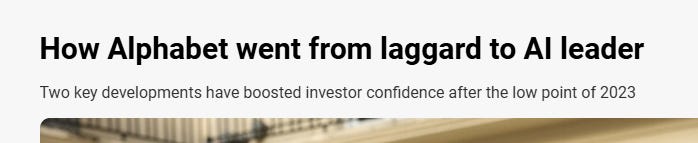
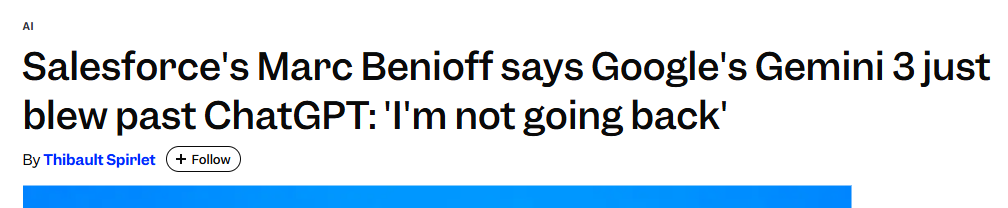
Here are recent articles reflecting the shifting tides
And then there’s this incredibly insightful observation from a handsome, wise, and humble man:
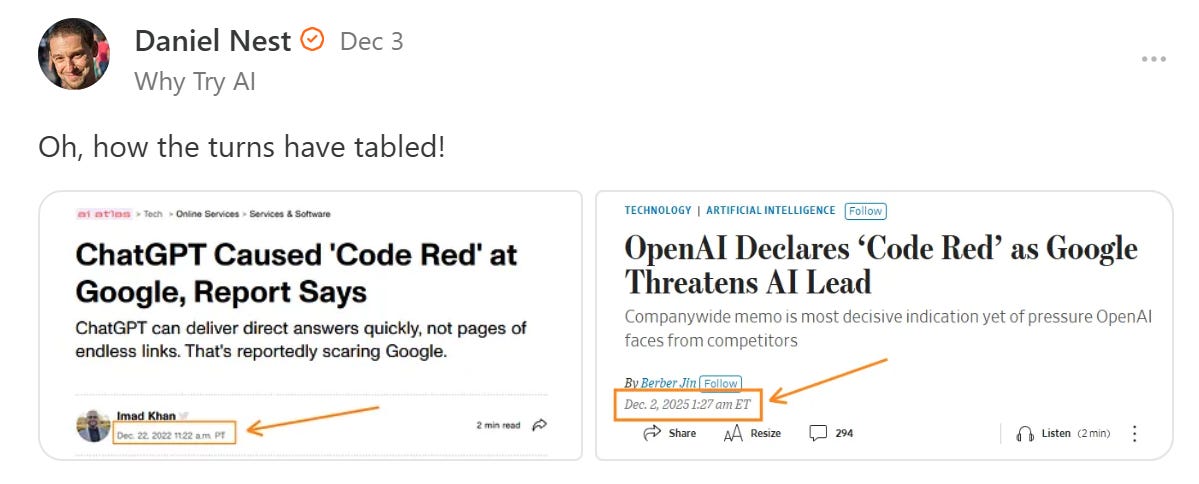
We went from “Google is dead” to “Google is winning” in the span of two years.
The change in Google’s standing in the eyes of the (betting) public is perhaps best captured by this Polymarket prediction chart:
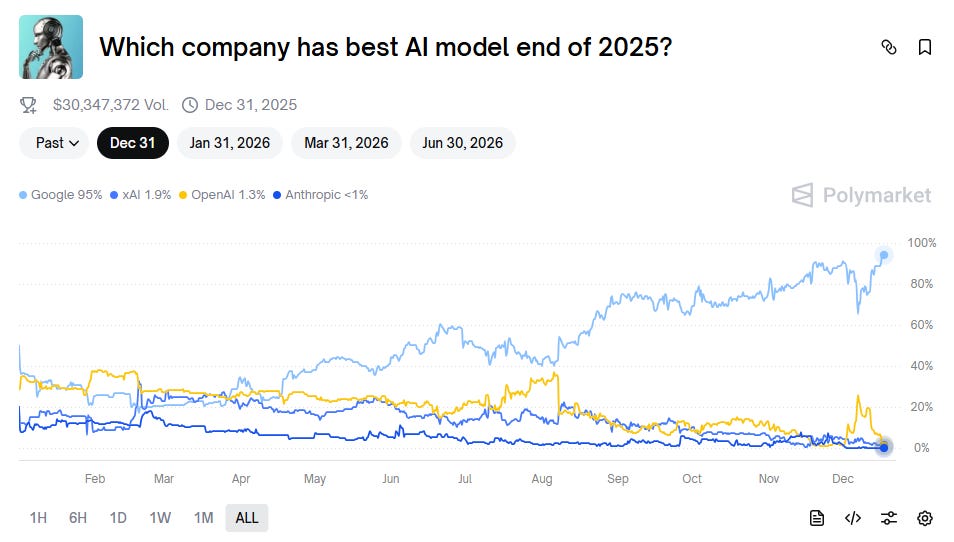
It’s telling that even OpenAI’s much-hyped GPT-5 launch in August only managed to briefly nudge the company into a “40% chance” territory.
OpenAI had two notable spikes on that chart, thanks to GPT-5 (August) and GPT-5.2 (December), but even these are minor blips that don’t detract from Google’s steady forward march.
Predictions for June next year also favor Google while nudging xAI into the second place, with OpenAI now third:
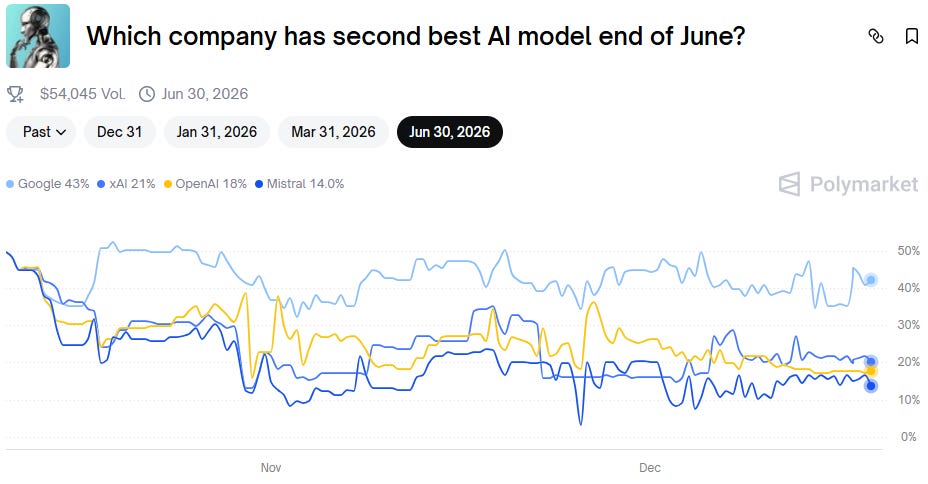
I feel pretty comfortable chalking this up as a win.
Verdict: Accurate ✅
Final score:
✅ Accurate = 4 predictions
🟨 Mixed = 1 prediction
❌ Wrong = 2 predictions
I’m not exactly the Nostradamus of the digital age, am I?
But neither am I completely crazy…if I say so myself.
🫵 Over to you…
Do you agree with my self-assessments? Have you made any predictions of your own? If so, how did they hold up?
Leave a comment or drop me a line at whytryai@substack.com.
Thanks for reading!
If you enjoy my writing, here’s how you can help:
❤️Like this post if it resonates with you.
🔄Share it to help others discover this newsletter.
🗣️Comment below—I love hearing your opinions.
Why Try AI is a passion project, and I’m grateful to those who help keep it going. If you’d like to support my work and unlock cool perks, consider a paid subscription:
It’s still my go-to for many reasoning tasks despite better models being available.
First, these are super fun and I am a sucker for prediction lists.
Second, I will point out that you made a prediction about Open AI's naming convention, not really about a model change or paradigm shift or whatever. Lesson learned here, though I also feel like we knew better a year ago. o3 5.2 reasoning deep research wants a word.
Also: the model transparency one is really a "people can't really be that dumb, can they" kind of question vs a technical one. I'm afraid the answer is pretty much always "yes" here.
Are you doing a year-end piece w/2026 predictions? These are good ones- esp the Google callout, although I think it's still kinda up in the air (but very evident that Google has a huge structural advantage).
Really interesting to see that both of our predictions were all directionally aligned, with the exception of regulation! I’m guessing it’s indicative of living in the US vs EU.