

Hey, remember AI Jest Daily?
My world-renowned, critically acclaimed collection of single-panel AI cartoons?
Of course you do!
AI Jest Daily was featured in such prominent publications as Why Try AI and hundreds—possibly billions—of others.1
It was a fun little experiment from the simple days of DALL-E 3 that ran for a respectable 500 issues. In the process, I learned what jokes AI is good at and where it “banana frisbee donkey fart burgers.”
But the real treasure was the friends I made along the way.
Right, friends? Friends?!
Well, that was awkward.
The point is that I’m no stranger to launching AI-assisted publications as silly side projects. And now that Claude can make entire animations from scratch, I figured, “Why not a YouTube channel?”
Why a faceless AI channel?
Look, I know exactly what you’re thinking!2
You’re thinking, “Great, more AI slop to clog up the already enshittified Internet. Thanks, Daniel, you AI-sshole.”
First, don’t be rude.
Second, “AI-sshole” sounds like just the kind of crappy wordplay I’d come up with myself. We should hang out.
If you’ve been following me for a while, you’ll know how I feel about breathless AI hype and low-effort AI content. (Spoiler alert: not a fan.)
Not wanting to contribute to the noise had kept me from even considering this idea. But another part of me has always been curious about testing the “AI channel” concept and reporting my findings.
So how does one square the two?
Well, what I ultimately decided to do was this:
Dust off my dormant social media channels (YouTube, Facebook, Instagram)
Come up with an AI-driven concept I could get behind
Try it out for a few weeks or months
Share what I learn with you (so you can laugh at the futility of my efforts)
The main question I’ll try to answer is: Can an AI-generated and mostly AI-run channel gain views and subscribers? Also, how much will I ultimately be able to outsource to AI? (Not an easy feat for a perfectionist micromanager like myself.)3
The experiment
Because of how little audience I have on all three channels, I decided to go the Shorts/Reels route. This also lets AI focus on shorter, tighter scripts and animations to begin with.
To make sure my taste and judgment remain intact, I’ll be testing two types of content:
Shorts based on my previous Why Try AI posts
Shorts where AI first interviews me about the topic before writing a script
I won’t run paid ads or do any other promotion, beyond posting about the experiment here on Substack. The point is to see whether AI can actually make something that grows the channels organically.
Who does what?
The split is simple.
I supply the opinions and the final approval. Every Short is grounded in something I wrote or my own takes.
AI does most of the heavy lifting when it comes to production and operations: writing the script, coding the animations, recording the narration, sounds, and music, writing the descriptions, and posting the final videos.
The goal is to get to a place where I only do two things:
Pick the post or topic to turn into a Short (and provide my takes)
Approve the video before it gets posted
It’s genuinely hard for me to let go of the nitty-gritty process, because I like getting my hands dirty. But the entire point of the experiment is to have it run as autonomously as possible.
Behind the scenes
I thought it’d be both fun and useful to share how things work under the hood.
The tools
There are two main ones:
Claude Code: My buddy Claude Opus 5.5 runs the entire show. It writes the scripts and creates the animations by drawing every frame in code. Claude also sends requests to ElevenLabs (below) and posts the videos to all three channels.
ElevenLabs: This is where everything you hear comes from: narration, music, and sound effects. Claude can code a few basic beeps and chiptune soundtracks, but I wanted more of a studio feel.
Beyond that, Claude uses a few third-party libraries for better animations and gets second opinions on scripts and videos from Gemini via API.
That’s basically the whole stack.
Let’s take a closer look at how it all came together.
The setup
You know the saying, “Give AI a fish, and it’ll call it a chicken. Teach AI to fish, and it will run your YouTube channel into the ground.”
If I wanted to remove myself from the equation, I first needed to help design a process that didn’t need me.
So here’s how I got things rolling.
1. Devising a plan
I first had Claude interview me about the idea itself, my goals, how I wanted things to run, etc. To do this, I used a modified version of Matt Pocock’s grill-me skill, which saves the plan to my drive at every step so any new chat or agent can pick things up.
This took about an hour of back-and-forth with Claude (thank God for voice input).
Once the concept was fleshed out, it was time to get the details in place.
2. Finding the right look
Most AI Shorts channels feature talking heads or 3D characters, so I decided to make things hard on myself for no good reason by going for a 2D look instead.
It ended up being quite the ordeal (see “micromanaging perfectionist”).
First, Claude made 10 stills in different styles, then I asked Claude to turn five of those into quick motion tests:
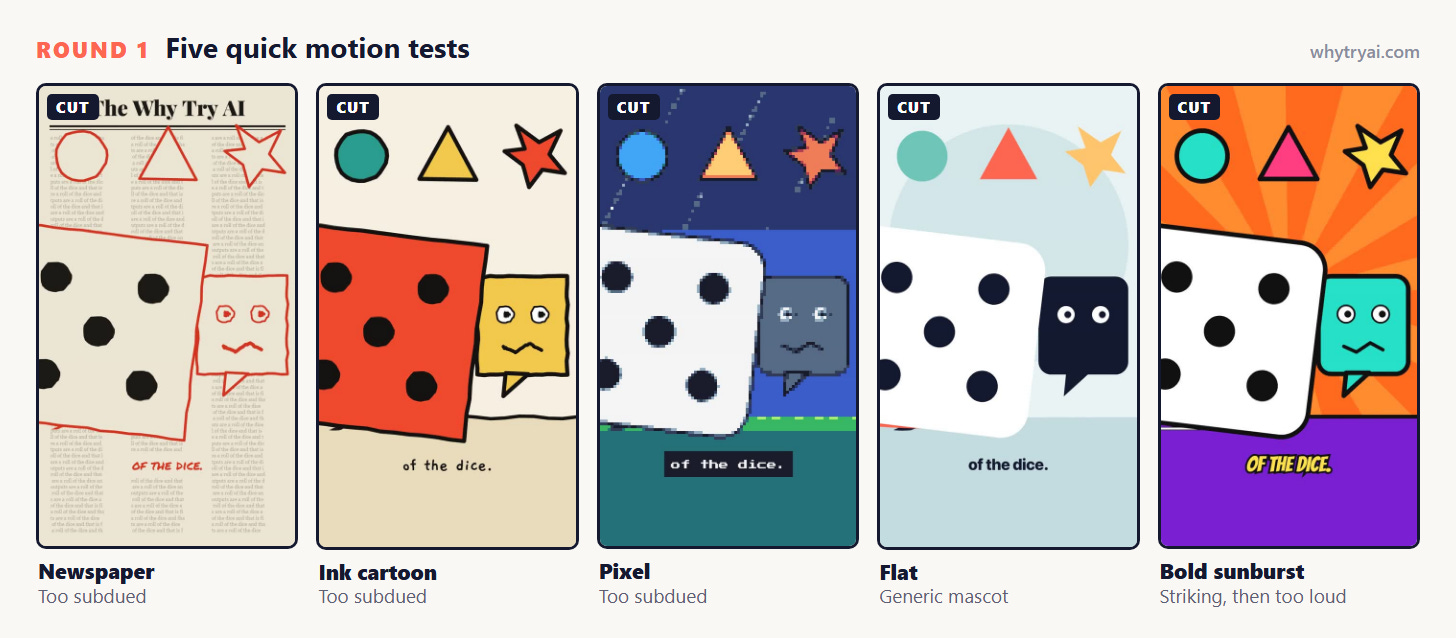
The problem was that all of these ended up like reskins of the same video, which wasn’t the point. So for round two, I asked for variation in both the script and the look. Claude obliged:
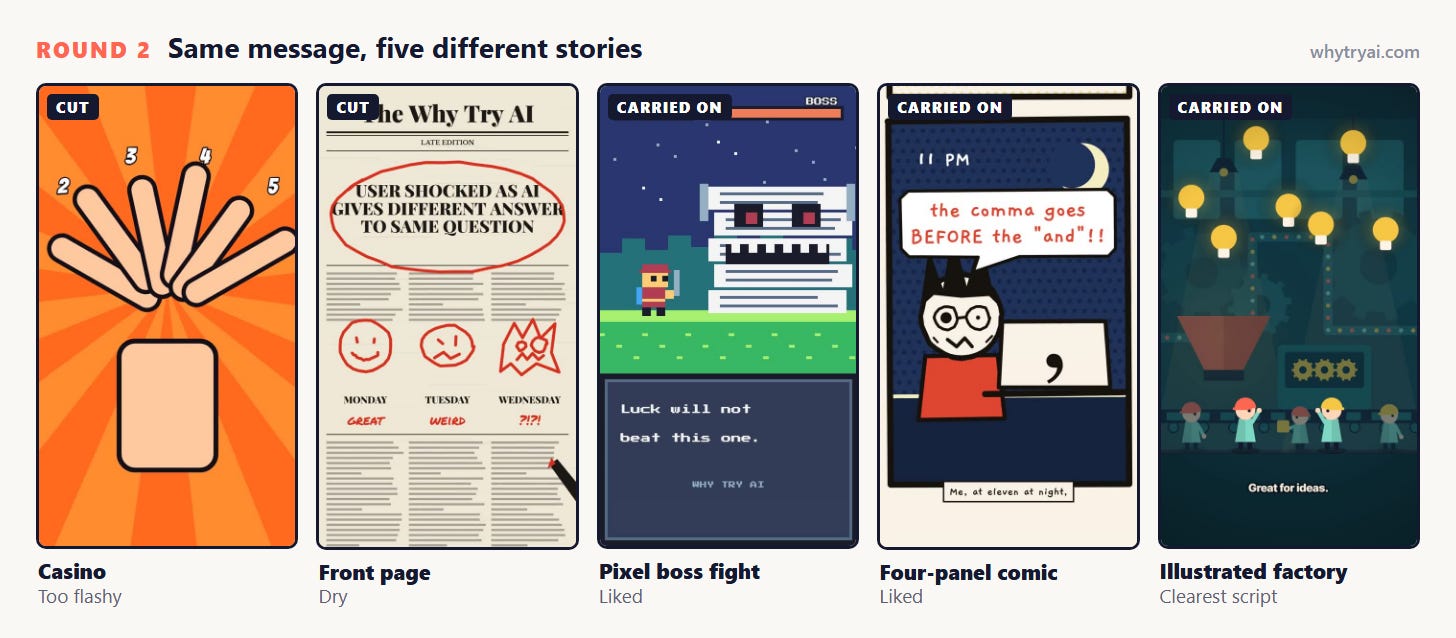
But then I realized that if I wanted to A/B test different visuals, I’d have to keep the script itself fixed (more on the scripts in #4).
So I ran the three surviving looks on the same test script:
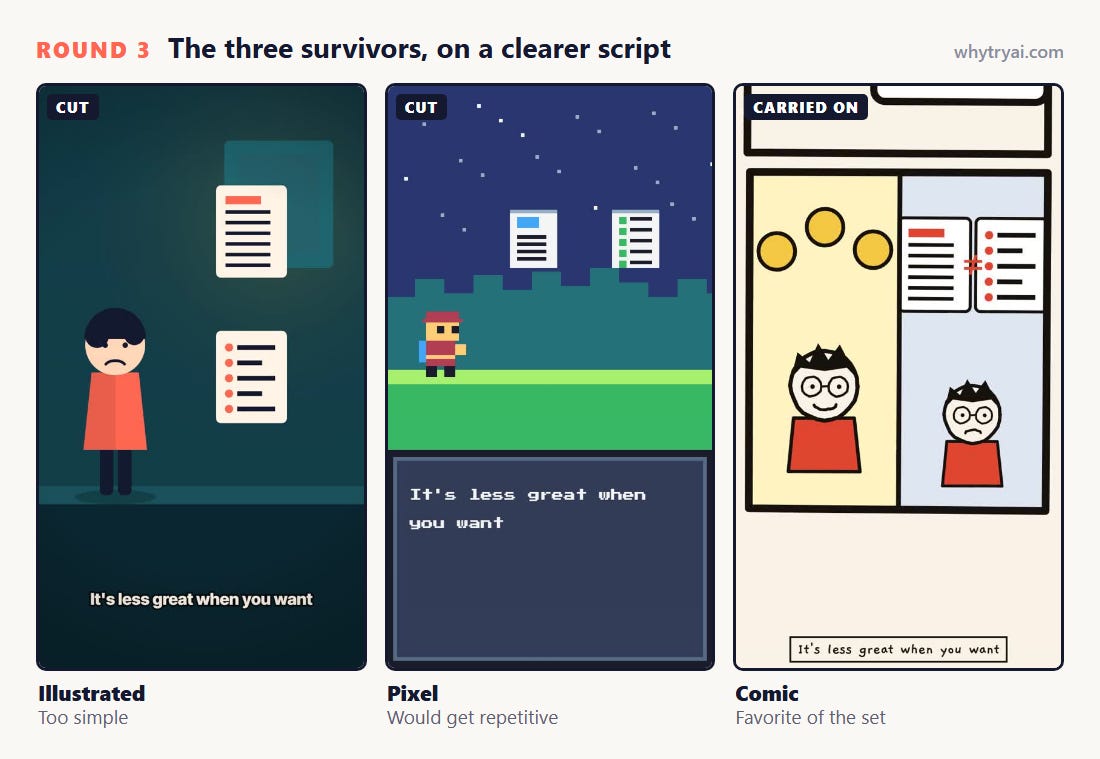
In the end, I also decided to minimize on-screen text and focus on drawn characters and objects with a narrator, background music, and sound effects.
To code or not to code?
One of the winning concepts was a comic animation that told the story over several panels and then zoomed out to bring the entire narrative together.
But the look itself wasn’t too pretty.
So I had ChatGPT draw a full comic page and let Claude move a camera across it. The art itself was definitely much richer:
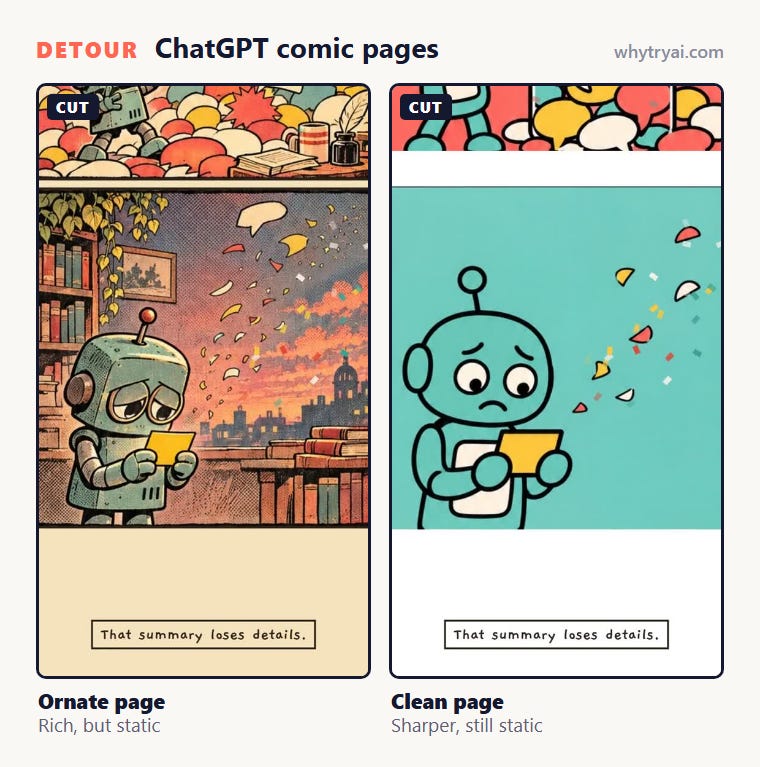
Sadly, nothing in the picture moved, so it didn’t really feel like proper animation.
I went back to square one: letting Claude draw everything in code.
But because I still wanted better-looking animations, I had Claude suggest ways to do that. It proposed using a free third-party library to improve character motion.
That helped: Claude’s animated robot went from looking like it desperately needed to pee to having functioning limbs:
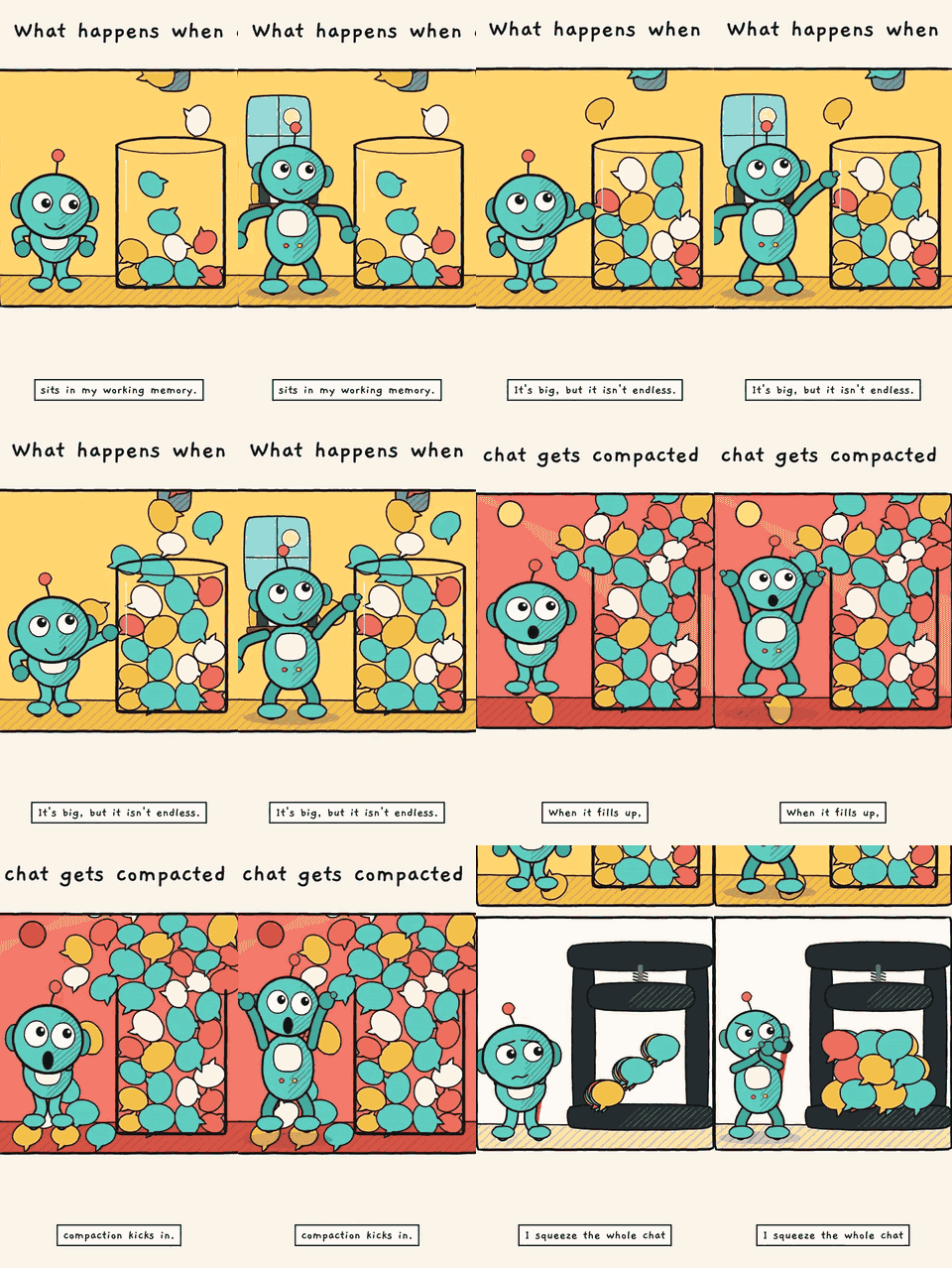
But the overall vibe wasn’t quite there yet.
New ideas need fresh agents
After several rounds of asking Claude for different styles and mostly getting minor variations of the same look…
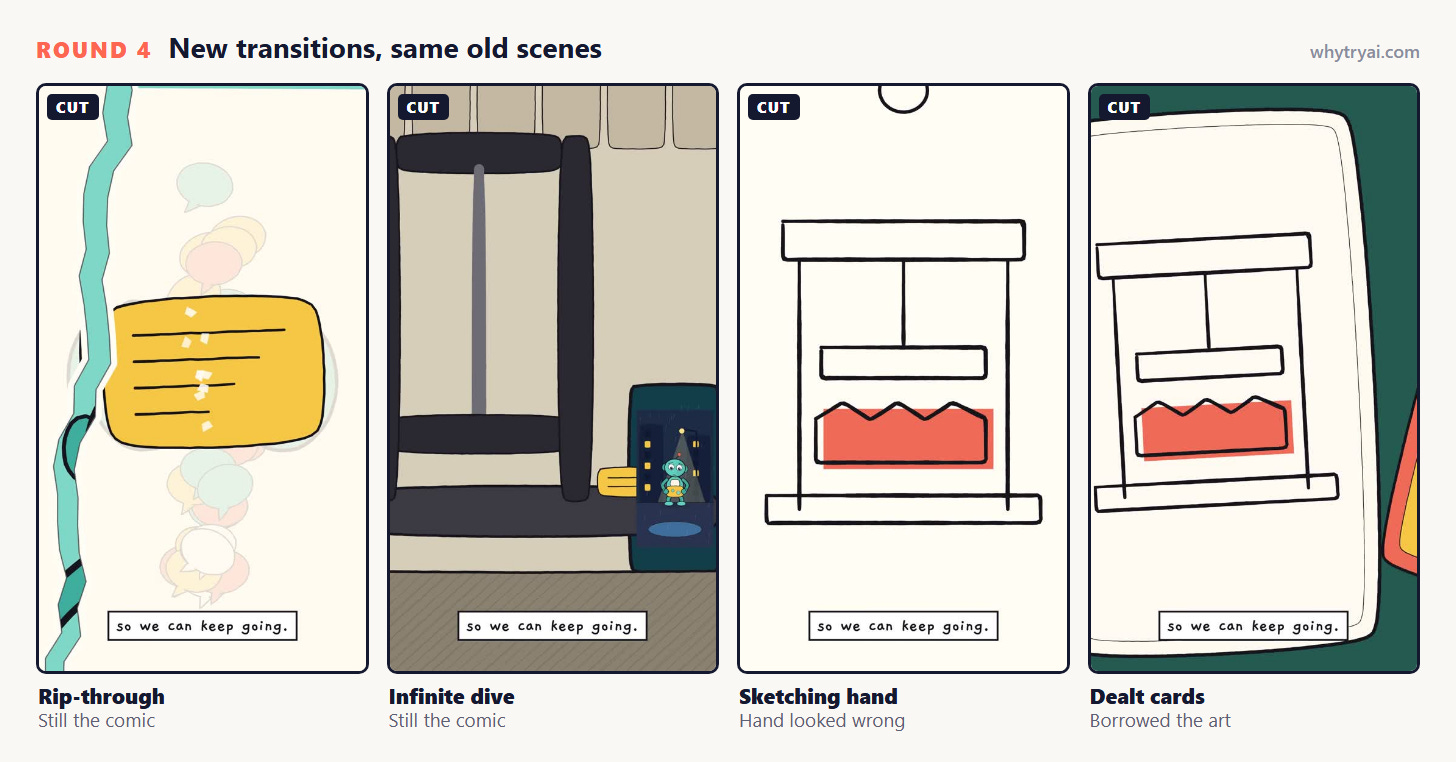
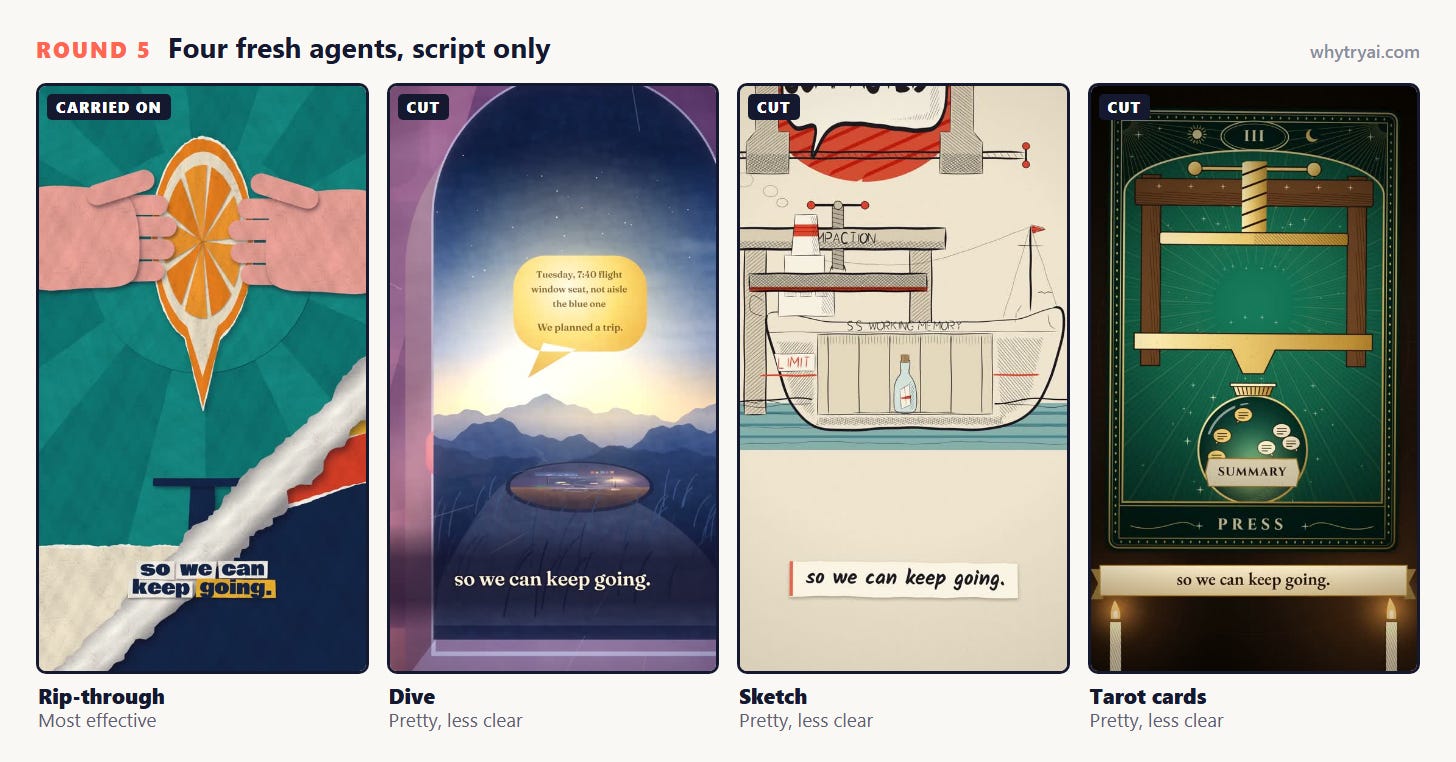
…I took my own advice and asked for context-free subagents to make the next batch of animations. Claude was too anchored to our existing chat to break out of it.

Each subagent got just the script and was asked to find a cool way to visualize it. That’s how I got four genuinely different animations:
Steal like an artist, remix like a DJ
Somehow, I still wasn’t quite satisfied.
So I ended up browsing this awesome AI Style Atlas from Futurepedia.
I picked eight styles I liked and asked Claude to give them a paper-and-print twist.
But I wasn’t quite ready to fully commit to the paper look—seriously, I need help—so I threw in some watercolor, shadow-and-light, and building blocks styles.
Claude and I tweaked those starting points into eight “house styles” that we applied to the same short script.
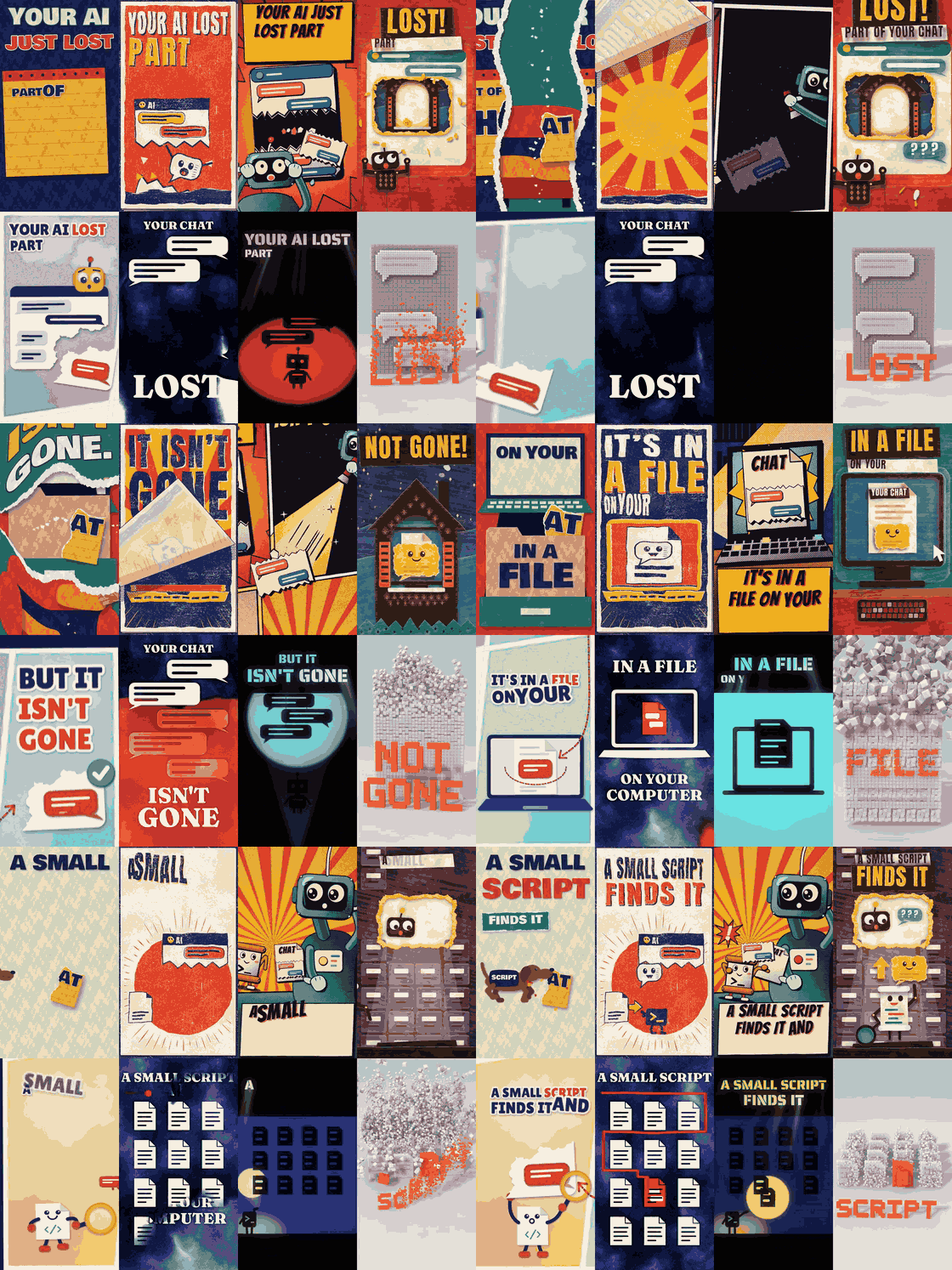
I finally settled on two paperlike styles for the initial A/B test period:
Pressroom, which looks like a printed poster coming to life
Comic Page, an evolution of our initial comic-panels-zoom-out-into-full-page
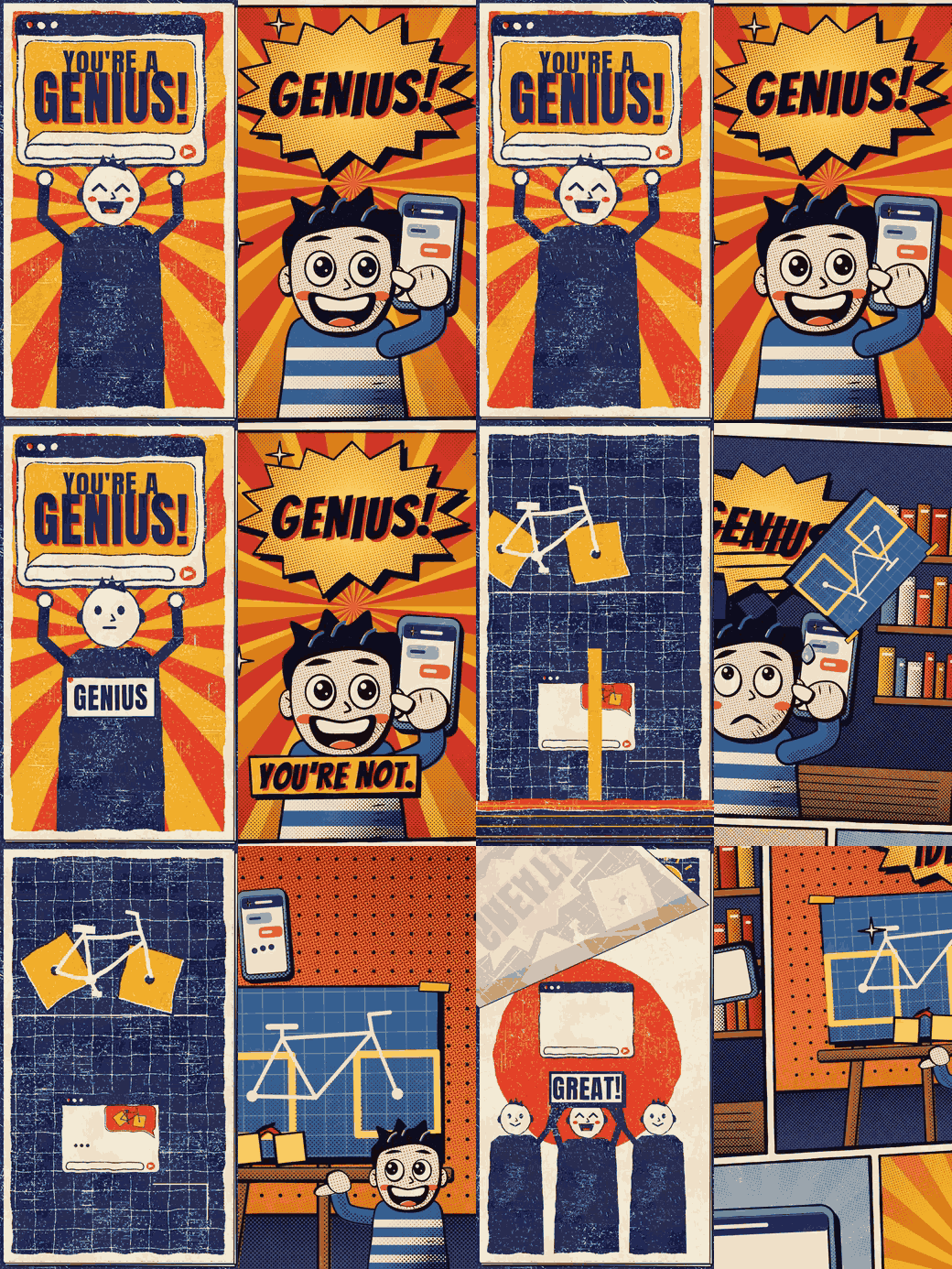
If this whole process sounds familiar, it’s because I talked about its close cousin, “Design Buffet,” a few weeks ago.

3. Plugging in the audio
I decided to treat myself and splurge on the ElevenLabs Starter plan.4
ElevenLabs offers the most expressive voice models, which matters for our narration. But the platform can also generate music and sound effects, so I get all the audio in a single place.
Claude is hooked up directly to ElevenLabs via API, so it can run the full pipeline on my behalf: requesting the audio, downloading it, splicing the sounds and narration into our video clips, and so on.
I leave sound effects and music mostly up to Claude, with a standing rule to keep them to a minimum.
Narration is where it’s at
Our scripts need a narrator.
At first, I tried to clone my own voice using the “instant voice cloning” option in ElevenLabs.
If I’m honest, I wasn’t wowed by the result. I had to read a four-minute script for ElevenLabs to clone my voice, and the clone was kind of “meh” compared to the best performers in my last year’s test, some of which only needed about 10 seconds.
Here’s “Daniel”:
Weird tonal shifts, jumping volume and emotion, not my cup of tea.
So then I had Claude pick 20 random “educator” voices and whittled those down to five: Alice, Bea, Daniel (no relation), Julian, and Ollie.
My final vote went to Bea, so I’ll be using her voice for the channel.
4. Designing a script-writing flow
This was the hardest part.
Writing’s my whole thing, so handing that off to AI was a bitter pill to swallow.
I didn’t like Claude’s first scripts, so we went through several rounds to create a sort of script-writing manual.
Claude would write a proposal, I’d edit it line by line, then Claude would turn my edits into general rules. Then Claude would use those to write a fresh script. Rinse, repeat.
The objective criteria we ended up with are quite straightforward:
The full script is 30-60 seconds.
The hook is max 6 words, or around 1-2 seconds.
Each Short tackles one relatable friction of using AI, along with a solution people can easily apply (yup, similar to my “quick fix” format).
Address the viewer (“you,” not “I”) and explain stuff like you’re talking to them.
But my subtler voice notes weren’t quite as easy to quantify, which is where judges come in.
5. Judges gonna judge
I don’t trust Claude to deliver a fleshed-out Short on its own.
So instead, I have several Claudes wearing different hats, pretending to be judges.
That’s right: Claude spins up tiny mini-Claudes (subagents) to review its own work.
Judges are involved at two points of the process:
Script writing
Here’s the current process:
Write 20-30 hooks and have the judges pick the best three.
Write three or more scripts from those hooks and have the judges compare them.
Hand me the winner to approve or rework.
Only then start on the narration and animation.
Eventually, I want to drop step #3 altogether, once we’ve sufficiently tightened the standing rules Claude writes from my feedback.
Video review
Gemini can actually see and hear video natively.
So when Claude finishes the video, it can send it to Gemini (via API) for screening before showing it to me.
6. Posting the first Shorts

With our test script ready, Bea’s voice chosen, and two visual styles locked, Claude built the first two Shorts:
Style #1: “Pressroom”
Style #2: “Comic Page”
Claude also published the Shorts to YouTube, Instagram, and Facebook via API.
And friends, we’re off to an epic start!
Feast your eyes on these impressive stats (both Shorts combined):
15 views on YouTube
2 viewers on Facebook
1,221 viewers and 23 likes on Instagram (wait, really?!)
At this pace, I expect to be a YouTube sensation in no time at all.
I promise not to let that imminent fame go to my head and to keep writing for you peasants here on Substack.
Now what?
The process is in place, so I now expect to publish around six Shorts a week (three scripts in the two styles).
So if you want to be among the first to watch my experiment crash and burn, follow along (@whytryai on all channels):
I’ll soon get Claude to build a nice dashboard to make it easier for you to keep up with those mad growth numbers.
Stay tuned!
Thanks for reading!
If you enjoy my stuff, here’s how you can help:
❤️Like this post if it resonates with you.
🔄Share it to help others discover this newsletter.
🗣️Comment below. I love hearing from my readers.
🔓Support me and unlock cool perks by going paid:
Don’t look it up. Just trust me, bro.
I gained the powers of telepathy after one of my other experiments had gone terribly wrong. But we don’t talk about that.
Also-also: How much will I hate myself at the end of this journey?
It’s $1 for the first month, so you know I mean business here!