

Ever since my first look at Claude Code at the start of this year, I catch myself throwing the word “agent” around as if it’s 100% self-explanatory.
But whenever I try to actually nail down the distinction between an AI agent and an AI chatbot, the line feels way blurrier than it used to.
Chatbots have gotten increasingly capable and can now do much of the stuff we used to ascribe to AI agents.
So today I want to zero in on what still separates an agent from a chatbot, at least as far as I can explain it.
Buckle up…or don’t…I’m not your parent.
Chatbots are becoming agentic…ish
Not so long ago, the split was nice and neat: “Chatbots talk. Agents do.”
Simples!
Some super-smart guy on Substack even made this clear-cut illustration to explain how Claude (the chatbot) differs from Claude Code (the agent):
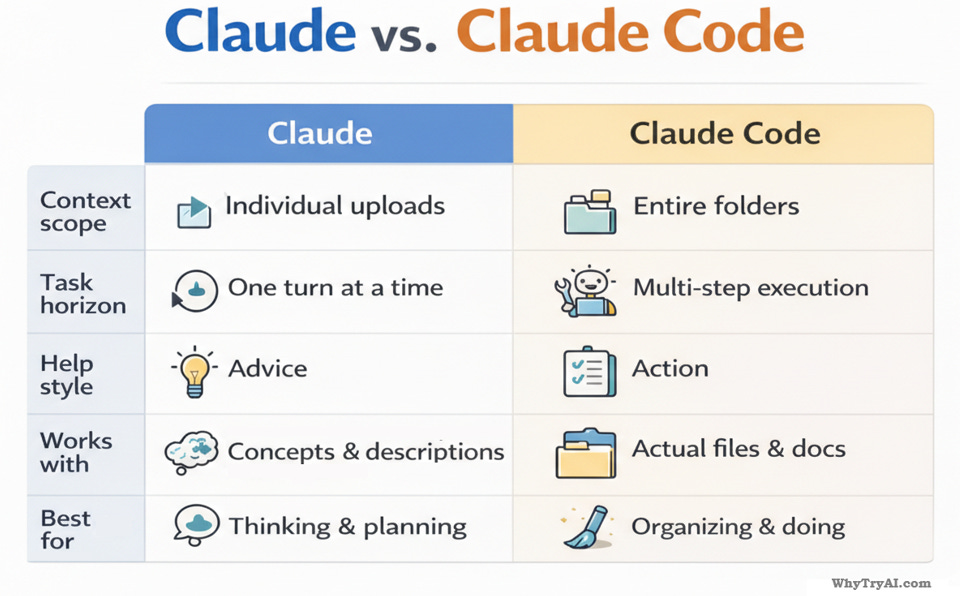
But most of those dividing lines aren't quite as clean anymore.
“Agents can perform multi-step tasks!”
Yeah, and Gemini (chatbot) can do multi-turn deep research that includes formulating a research query, discovering initial sources, analyzing them to identify further research paths, surfacing and comparing additional sources, and synthesizing its findings into a polished report. Is Gemini an AI agent?
“Well, agents can directly use third-party tools!”
Right, but just today I had ChatGPT (chatbot) schedule a whole bunch of events in my calendar thanks to a nifty Google Calendar plugin. Is ChatGPT an AI agent?
“Okay, but AI agents can actually build stuff!”
Sure, so can Claude (chatbot) when I ask it to create and tweak interactive artifacts for me to use. Is Claude an AI agent?
The truth is, what used to be a barebones chat experience is now a lot more.
Chatbots have cross-conversation memory, can code and work with files, use external connectors, and run tasks on a schedule.
In short, chatbots are slowly climbing the agentic ladder.

So what exactly makes an agent an agent, then?
To me, a true agent removes you as the secretarial bottleneck between AI and its work.
A chatbot—for the most part—still relies on you to upload working documents and download its outputs.
An agent doesn’t need you for these steps.
This sounds like a minor quibble, but it’s the difference between colleagues emailing each other multiple versions of a document1 vs. the same colleagues working directly on a single shared Google Doc.
In practice, this gives an AI agent three key capabilities:
It can “see” everything
It can “touch” anything
It closes the loop
Let’s tackle these in order.
1. An agent can “see” everything
Chatbots have a sort of memory now, where certain things about you carry between chats. You can even curate some of these memories.
But with an AI agent, you don’t have to “feed” it context. If a piece of information is in your project folder—or anywhere else it’s allowed to work—the agent will find it.
This means you can start a brand new chat, tell the agent what you’re working on, and it’ll automatically search for and pick up any relevant information.

2. An agent can “touch” anything
First, get your mind out of the gutter.
Second, this part is an extension of being able to “see” everything.
When a chatbot is done working, it hands you a document and says, “Here, save this!”
But an agent just…saves it. Wherever you need it to: your local drive, GitHub repo, a website, you name it.
This “last mile” is invaluable because it often eliminates annoying and manual download/upload chains (see my “Netlify update” example), where you turn into a glorified file courier for AI.
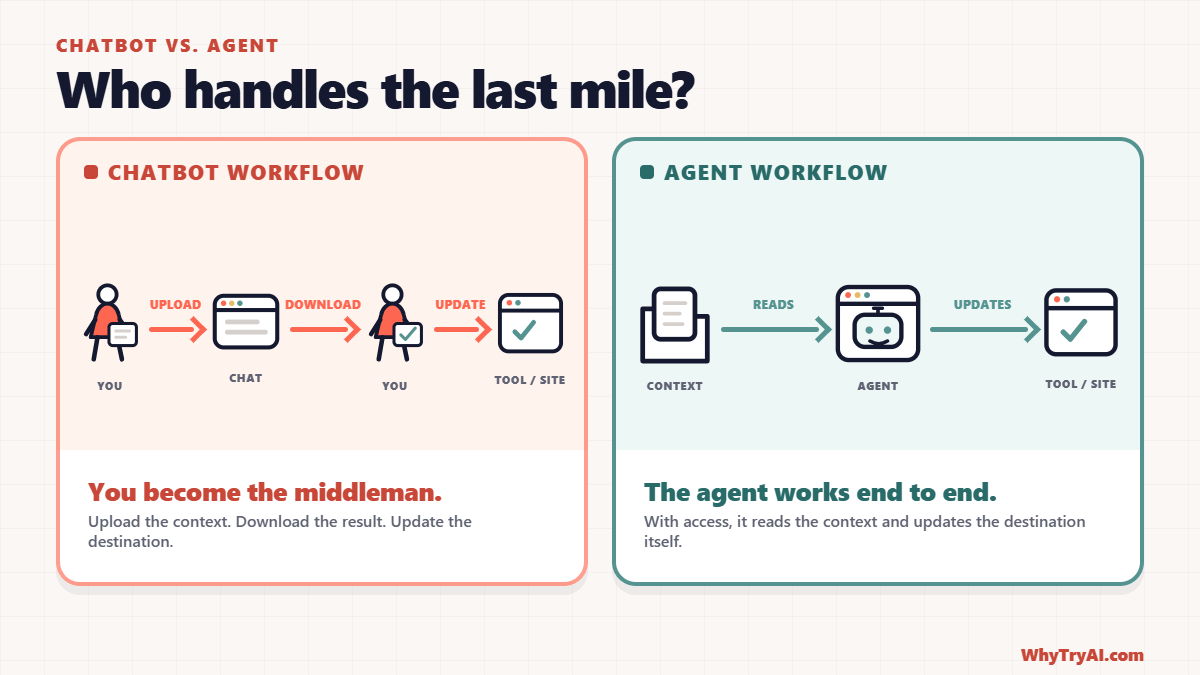
But this also means your agent can work with just about any interface or third-party app, automatically picking the right tool for the job. Unlike a chatbot, an agent isn’t limited to pre-approved connectors.
Ask an AI agent to work on, say, a website, and it might first look for an existing connector or plugin. If none exist, it may try to use a script or reach the website via API. If all else fails, the agent will simply open a browser and work directly in the UI thanks to “computer use.”
3. An agent closes the loop
When both #1 and #2 are true, the AI agent becomes genuinely self-sufficient at long-running productive work.
It can both do stuff and then evaluate its own work.2
It doesn’t need you in the loop.
That’s exactly what makes hypey concepts like “loop engineering” possible: Agents can keep running build-verify-fix loops until they meet a goal, for as long as it takes.3
The chatbot-agent spectrum
The chatbot vs. agent split isn’t exactly a binary.
In reality, frontier AI companies offer a range of products on a spectrum.
For instance, OpenAI has:
ChatGPT.com (chatbot with some agentic features)
ChatGPT Work (a sandboxed agent with partial access to folders and connectors)
Codex (local agent with full access)
Anthropic has a very similar three-tier mapping:
Claude.ai
Claude Cowork
Claude Code
You can move up the ladder to let AI work more autonomously based on your needs.
Things in AI are moving hella fast, but I tried to map the current landscape for all major AI players in the US here:4
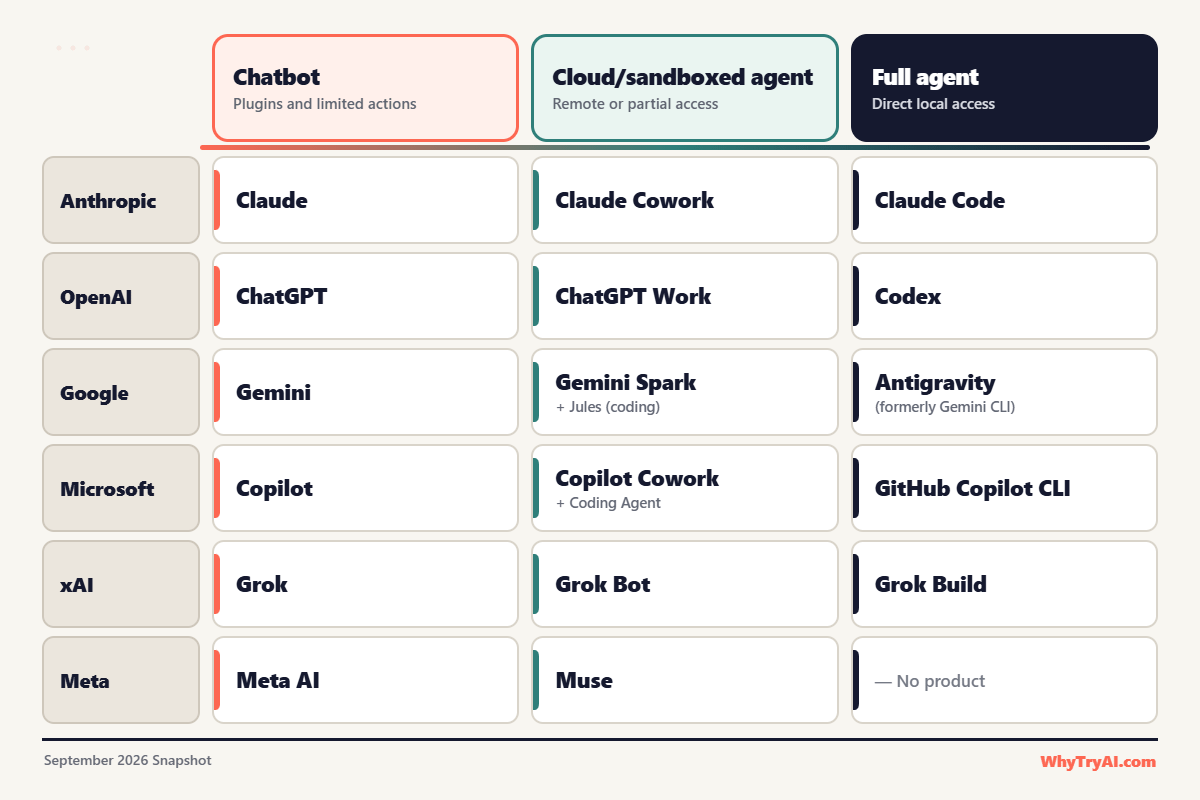
Here’s what the columns mean:
Chatbot: Designed for back-and-forth conversations but can work with uploads and reach third-party tools via dedicated plugins or connectors. Generally needs you to initiate work and act as the middleman.
Cloud/sandboxed agent: Works inside a sandboxed cloud environment and/or can access specific local folders. Close to being truly agentic but with some guardrails and limitations in place.
Full agent: Can access the entire local filesystem, run commands, and reach practically any third-party tool that’s accessible via the Internet. Meets all three capabilities I covered above.
This also serves as a handy shortcut to understand what I mean by “chatbot” or “agent” in my past and future Why Try AI posts.
Timely announcement: “Claude Code Essentials” is now “AI Agent Hub”
I created “Claude Code Essentials” for my paid subscribers back in March, when Claude Code was the only agent I worked with.
Since then, I onboarded ChatGPT Codex and realized that an organized and well-maintained local workspace can be used effectively by any agent.
So I just gave Claude Code Essentials a major overhaul and a facelift.
It has become the “AI Agent Hub”:
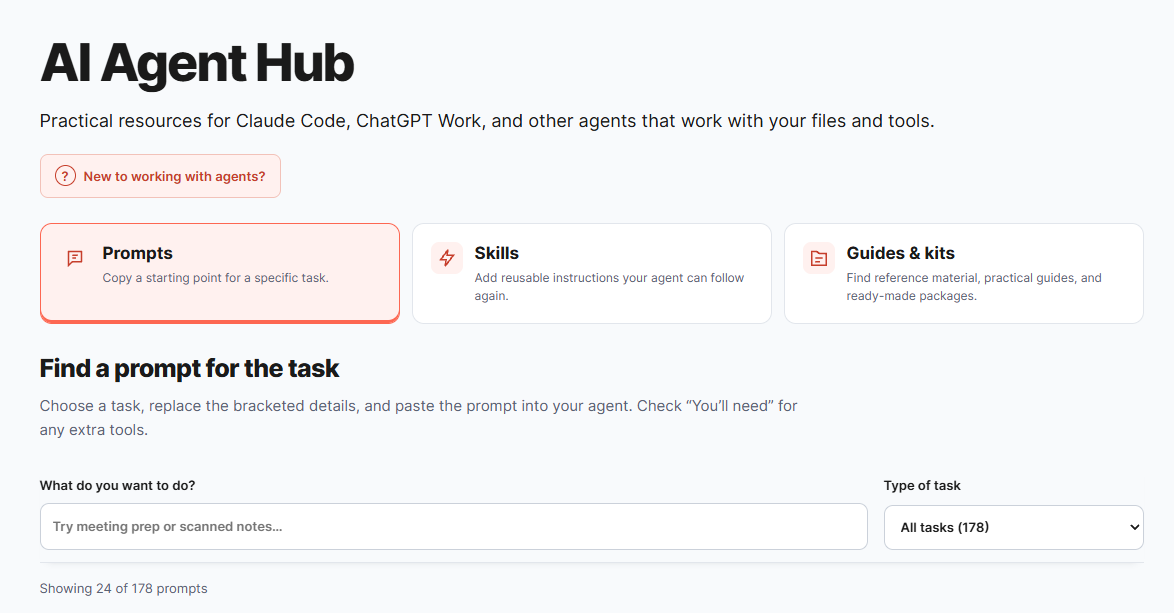
The prompts, guides, and self-installing skills inside the hub are now agent-agnostic.
So whether you use Claude Cowork/Code, ChatGPT Work/Codex, or another agent, the resources here should work for you.
Enjoy:
Thanks for reading!
If you enjoy my work, here’s how you can help:
❤️Like this post if it resonates with you.
🔄Share it to help others discover this newsletter.
🗣️Comment below. I love hearing from my readers.
🔓Support me and unlock cool perks by going paid:
Until Sam sits with “document_final17” while Annie is still tweaking “document_final_really_final_v2”
“Touch” + “see”
Or at least until you run out of tokens.
If you have better insights or corrections, let me know so I can keep this accurate!